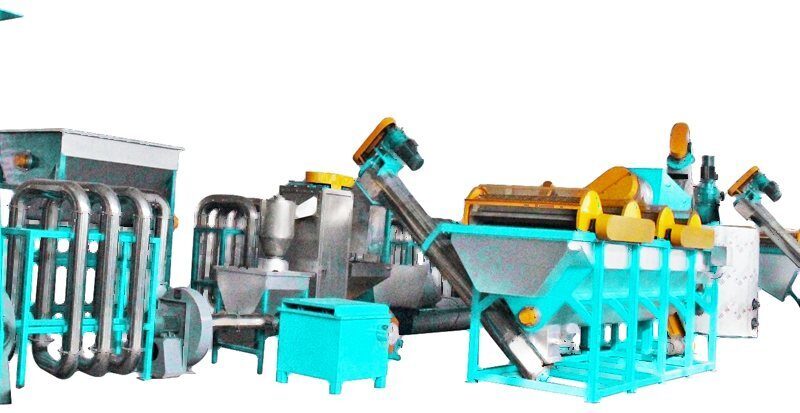
PET bottle washing line.
Clean flake, six capacity points.
A complete PET bottle washing line for baled or loose bottles, PET flake and post-consumer packaging. Select the model by actual output, contamination and target flake quality.
The washing line should create a predictable feedstock for your pelletizer.
PET bottle recovery is a chain of quality decisions: how completely labels and caps are separated, how much glue remains after hot washing, how consistently flake is dried and how smoothly it enters the next process.
BENK-PWL-PET is a dedicated washing family. It starts with bottle receiving and sorting, then combines pre-wash, wet crushing, hot washing, friction washing, float-sink separation, rinsing and drying. The model is chosen from the material condition and required flake output — not from a single catalogue capacity.
Remove the problem early
De-baling, trommel screening, metal removal, label removal and colour sorting reduce contamination before the wash circuit.
Control temperature and chemistry
Pre-wash, hot wash and high-speed friction washing are matched to glue, label and soil load.
Stable feed for extrusion
Mechanical dewatering plus thermal drying reduce moisture variation and protect pelletizer output.
Six capacity points
500, 1,000, 2,000, 3,000, 4,500 and 6,000 kg/h reference models cover small, mid-size and high-volume PET recovery.
From bottle bale to clean, dry PET flake.
Each model uses the same process logic, but washing volume, conveyor width, tank size and drying capacity scale with the selected output.
De-bale & feed
Break up compacted bales and meter bottles into sorting at a controlled rate.
Sort & de-label
Remove metals, stones, loose labels and non-PET fractions; release labels and caps.
Pre-wash
Loosen soil and reduce the contamination load entering hot washing.
Wet crushing
Reduce bottles to controlled flake size while flushing away light contaminants.
Hot & friction wash
Controlled temperature, dwell and friction remove glue, oils and residual soil.
Rinse & separate
Float-sink separation removes caps and PP/PE; rinse stages polish the flake.
Dewater & dry
Centrifugal and thermal drying produce a stable moisture level for buffering.
Flake transfer
Clean flake is packed for sale or transferred to a separate PET pelletizing line.
Complete PET washing line model range.
Six reference models cover different outputs, footprints and utility requirements. Confirm the final model against your bottle source, contamination, target flake size and available building space.
| Model | Capacity | Installed power | Footprint | Operators | Steam / air | Water |
|---|---|---|---|---|---|---|
| BENK-PWL-PET-0500 | 500 kg/h | ≈220 kW | ≈400 m² | 8 | 350 kg/h / 4 m³/min | ≈1 m³/h |
| BENK-PWL-PET-1000 | 1,000 kg/h | ≈500 kW | ≈750 m² | 10 | 500 kg/h / 10 m³/min | ≈3 m³/h |
| BENK-PWL-PET-2000 | 2,000 kg/h | ≈700 kW | ≈1,000 m² | 12 | 800 kg/h / 15 m³/min | ≈5 m³/h |
| BENK-PWL-PET-3000 | 3,000 kg/h | ≈900 kW | ≈1,500 m² | 12 | 1,000 kg/h / 15 m³/min | ≈6 m³/h |
| BENK-PWL-PET-4500 | 4,500 kg/h | ≈1,000 kW | ≈2,200 m² | 16 | 1,300 kg/h / 18 m³/min | ≈8 m³/h |
| BENK-PWL-PET-6000 | 6,000 kg/h | ≈1,200 kW | ≈2,500 m² | 16 | 1,800 kg/h / 18 m³/min | ≈10 m³/h |
For a 1,000 kg/h finished-flake target, start with BENK-PWL-PET-1000, then confirm the actual input condition and drying requirement. For a bottle-to-pellet project, match it with a PET pelletizing line sized from the washed bulk density.
Quality is a specification, not a promise.
Typical targets for a well-matched PET bottle washing line are shown below. Actual results depend on bottle source, pre-sorting, chemistry and the final application.
PET line detail and service access.
The washing and drying modules are arranged for material flow, water containment and maintenance access.
Clean PET flake for several product routes.
Washing and drying parameters can be tuned for fibre, sheet, strapping, thermoforming and food-grade rPET production.
Polyester fibre and filament
rPET sheet and thermoforming
PET strapping and monofilament
Food-grade rPET with optional SSP
Injection-moulded articles
PCR blends for packaging
Add only the modules your market pays for.
Start with the required washing performance, then add automation, water treatment or food-grade capability when the product plan justifies it.
Washing produces flake. Pelletizing creates the sellable rPET pellet.
Compare the separate PET flake pelletizing range, including filtration, vacuum degassing, water-ring or strand cutting and optional SSP.
One engineering team from material review to stable production.
BENK engineers and manufactures plastic extrusion, washing and pelletizing equipment in Zhangjiagang, China. The recycling team works from a material sample and target output through layout, machine selection, factory testing, installation and operator training.
Long-running engineering and manufacturing experience in plastic extrusion and recycling equipment.
Washing stages, drying method and pelletizing configuration are selected from the actual feed and contamination profile.
Line sections are assembled and trial run before shipment, with output and operating records for the agreed test material.
Process design, plant layout, utilities, installation, commissioning and training can sit under one project team.
Quality-controlled fabrication and assembly with CE-compliant electrical and safety components.
Remote diagnostics, spare parts and process optimization support for the operating life of the line.
Build the right process around the line.
Compare the complementary washing or pelletizing stage, or read the full selection guide before requesting a quotation.
Useful reading before you compare plastic recycling line prices.
These practical guides explain how capacity, contamination, drying and pellet quality decide the real cost and return of a washing or pelletizing line.
How to choose the right washing line capacity
Why nominal kg/h is not enough, and how to size washing, drying and pelletizing as one mass balance.
Read the guide → PET recyclingPET bottle to rPET pellets: the complete route
From bale opening and hot washing to filtration, vacuum degassing, pelletizing and optional SSP.
Explore PET processing → Film & rigidWhy drying determines pellet quality
How moisture, bulk density and contamination change the choice between film and rigid pelletizing systems.
Compare line options →Send the material and capacity target. BENK will map the closest washing and pelletizing models before you request a formal quotation.
PET washing line questions buyers ask first.
The most useful enquiry includes the bottle source, bale or loose feed, contamination, target flake quality and required output.
Can the line run baled and loose bottles?
Yes. A de-baler and metering conveyor are used for bales; a simpler infeed is used for loose bottles. Sorting and washing are sized from the same mass balance.
How do I choose among 500 to 6,000 kg/h models?
The nominal washing capacity should be matched to your actual feed, contamination and target flake output. A 1,000 kg/h model is a common starting point for industrial projects, while larger models require more space and utilities.
Can I buy the washing line without the pelletizer?
Yes. BENK sells the washing line as a separate product family. The line can discharge clean, dried flake for sale or feed a later pelletizing investment.
What determines water consumption?
Soil load, rinse stages and water-recycling scope determine fresh-water demand. A closed-loop water-treatment package can reduce intake and discharge volume.
Which model should I choose for food-grade rPET?
The washing model must deliver low moisture and low contamination, then the pelletizing and optional SSP modules must be specified for food-contact requirements. The final scope depends on the target market and certification route.
Get a recommended model, budget range and delivery estimate.
Give BENK the material, contamination level, target output and end product. Our engineers will review the duty and reply with a sized washing or pelletizing line — not a generic catalogue answer.