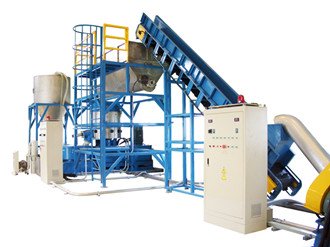
PET flake pelletizing line.
Six models for rPET pellets.
A separate PET pelletizing line for washed bottle flake, sheet scrap and selected PET waste. Select the model by bulk density, moisture, filtration, IV target and required output.
A pelletizer cannot correct a flake specification it was never designed for.
PET pelletizing starts with dry, low-contamination flake. The line then controls melt temperature, filtration, vacuum degassing and cutting so the pellet can be used in fibre, sheet, strapping or food-grade rPET production.
BENK-PRL-PET is a separate pelletizing family. It can be fed by a BENK PET washing line or an existing washed-flake supply. Capacity models range from 300 to 2,000 kg/h, with optional SSP or LSP modules for higher IV and food-grade routes.
Pre-crystallization and drying
Remove surface moisture and prevent oxidation or yellowing before melting.
Single or twin-screw platform
Screw geometry and venting are selected from bulk density, IV target and filtration demand.
Melt filtration and degassing
Hydraulic screen changing and vacuum degassing improve pellet purity and bubble control.
Water-ring or strand cutting
Cutting, cooling, dewatering and screening are matched to the target pellet shape.
Optional SSP / LSP
Solid-state or liquid-state polymerization raises IV and supports food-grade rPET production.
Six capacity points
300, 500, 800, 1,000, 1,500 and 2,000 kg/h reference models cover different projects.
From washed PET flake to consistent rPET pellets.
The pelletizing line is sized from the flake condition and final application. The washing line is a separate upstream decision.
Flake receiving
Transfer washed PET flake into a buffer or drying hopper.
Pre-crystallization
Heat and dry the flake to prevent caking and oxidation.
Extrusion
Melt the flake with controlled shear and temperature.
Filtration
Remove residual solid contamination through a screen changer.
Vacuum degassing
Remove moisture, air and volatile substances.
Pelletizing
Cut into pellets by water-ring or strand system.
Dewater & screen
Cool, dewater and screen the pellets for size consistency.
SSP / packing
Optional IV enhancement, storage and bagging.
Complete PET pelletizing model range.
Six reference models cover small and industrial rPET pelletizing projects. The right model depends on flake bulk density, moisture, filtration and target pellet quality.
| Model | Output | Screw | Main motor | L/D | Cutting |
|---|---|---|---|---|---|
| BENK-PRL-PET-0300 | 300 kg/h | Single screw | ≈90 kW | 33:1 | Water-ring / strand |
| BENK-PRL-PET-0500 | 500 kg/h | Single screw | ≈132 kW | 33:1 | Water-ring / strand |
| BENK-PRL-PET-0800 | 800 kg/h | Single screw | ≈185 kW | 33:1 | Water-ring / strand |
| BENK-PRL-PET-1000 | 1,000 kg/h | Single / twin screw | ≈250 kW | 33:1 | Water-ring / strand |
| BENK-PRL-PET-1500 | 1,500 kg/h | Twin screw | ≈315 kW | 32:1 | Water-ring / strand |
| BENK-PRL-PET-2000 | 2,000 kg/h | Twin screw | ≈400 kW | 32:1 | Water-ring / strand |
For a 1,000 kg/h washed-flake supply, start with BENK-PRL-PET-1000. If the final product requires food-grade IV, include the SSP module in the same technical review.
Pellet quality starts with controlled melt quality.
Filtration, vacuum degassing and temperature control decide whether the pellet is bubble-free, colour-stable and suitable for the next process.
Melt filtration, degassing and pelletizing detail.
The pelletizing section is compact relative to the washing line but has a decisive effect on final product value.
rPET pellets for value-added products.
The final pellet can be specified for fibre, sheet, strapping, thermoforming or bottle-to-bottle applications.
Polyester fibre and filament
rPET sheet and thermoforming
PET strapping and monofilament
Food-grade rPET with SSP
Injection-moulded articles
PCR compounds and packaging
Configure the pelletizer around the final pellet.
Filtration, degassing, cutting and IV control should be selected from the product specification, not from the upstream washing line alone.
The pelletizer needs a washline specification, not a guess.
Compare six PET bottle washing models from 500 to 6,000 kg/h and match flake quality to pelletizing output.
One engineering team from material review to stable production.
BENK engineers and manufactures plastic extrusion, washing and pelletizing equipment in Zhangjiagang, China. The recycling team works from a material sample and target output through layout, machine selection, factory testing, installation and operator training.
Long-running engineering and manufacturing experience in plastic extrusion and recycling equipment.
Washing stages, drying method and pelletizing configuration are selected from the actual feed and contamination profile.
Line sections are assembled and trial run before shipment, with output and operating records for the agreed test material.
Process design, plant layout, utilities, installation, commissioning and training can sit under one project team.
Quality-controlled fabrication and assembly with CE-compliant electrical and safety components.
Remote diagnostics, spare parts and process optimization support for the operating life of the line.
Build the right process around the line.
Compare the complementary washing or pelletizing stage, or read the full selection guide before requesting a quotation.
Useful reading before you compare plastic recycling line prices.
These practical guides explain how capacity, contamination, drying and pellet quality decide the real cost and return of a washing or pelletizing line.
How to choose the right washing line capacity
Why nominal kg/h is not enough, and how to size washing, drying and pelletizing as one mass balance.
Read the guide → PET recyclingPET bottle to rPET pellets: the complete route
From bale opening and hot washing to filtration, vacuum degassing, pelletizing and optional SSP.
Explore PET processing → Film & rigidWhy drying determines pellet quality
How moisture, bulk density and contamination change the choice between film and rigid pelletizing systems.
Compare line options →Send the material and capacity target. BENK will map the closest washing and pelletizing models before you request a formal quotation.
PET pelletizing line questions.
The pelletizer is only as stable as the flake specification. Start with moisture, contamination and the final IV target.
Can I feed flake from an existing washing line?
Yes, provided the flake meets the moisture, contamination and bulk-density assumptions used to size the pelletizer. A sample test is recommended.
Which model is right for 1,000 kg/h?
BENK-PRL-PET-1000 is the direct reference model. For food-grade or high-IV products, include the SSP or LSP review before final selection.
Do I need a twin-screw extruder?
Twin-screw extrusion is considered for higher output, better mixing or specific compounding requirements. Single-screw systems can be suitable for many washed-flake duties.
How is IV controlled?
IV is controlled through the extrusion/devolatilization process and, where required, an SSP or LSP module. The target IV and application must be stated in the enquiry.
Can the line produce food-grade rPET?
A food-grade route requires stricter washing, validated decontamination, controlled extrusion and optional SSP. The scope depends on the target market and certification route.
Get a recommended model, budget range and delivery estimate.
Give BENK the material, contamination level, target output and end product. Our engineers will review the duty and reply with a sized washing or pelletizing line — not a generic catalogue answer.