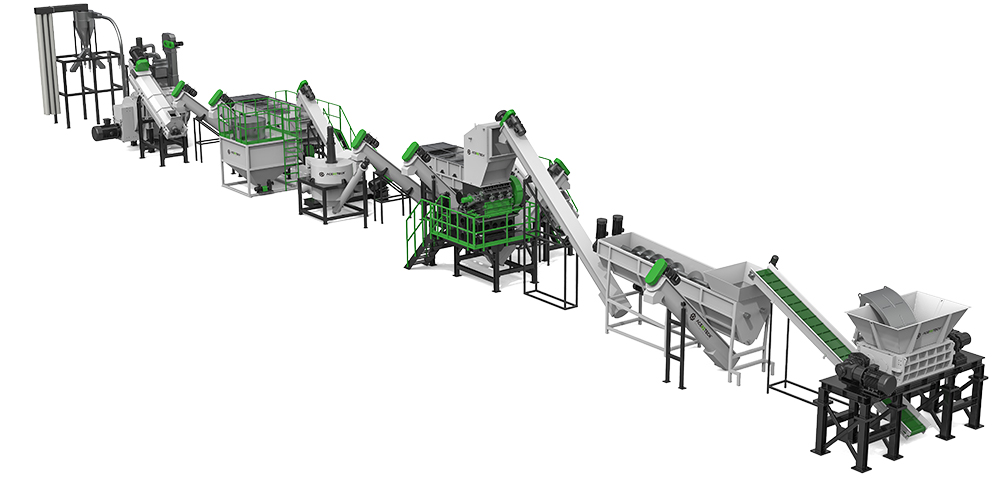
HDPE/PP rigid plastic washing line.
Five models from 500 to 4,000 kg/h.
A heavy-duty washing line for HDPE/PP bottles, crates, drums, household containers and selected rigid scrap. Select the model by object size, contamination, target flake size and output.
The difficult part is separating the plastic from everything that came with it.
Rigid plastic recovery often begins with bulky, mixed and heavily contaminated objects. The line must reduce size, open the material, separate heavy and light fractions, remove organics and labels, then dry the flake consistently enough for extrusion.
BENK-PWL-RGD combines heavy-duty shredding and pre-wash with friction washing, float-sink separation, centrifugal drying and thermal drying. The selected model determines conveyor width, shredder size, washing volume and drying capacity.
Heavy-duty shredding
Hydraulic ram feeding and a reinforced cutting chamber handle bottles, crates, drums and bulky rigid scrap.
Float-sink and friction wash
Remove heavy plastics, metals, sand and organics while friction cleaning strips surface contamination.
Dry flake, stable melt
Centrifugal and pipeline hot-air drying reduce moisture before buffering and extrusion.
Five capacity points
500, 1,000, 2,000, 3,000 and 4,000 kg/h reference models serve different plant sizes.
Open the material. Separate the problem. Dry the flake.
The process is front-loaded: the more contamination removed before extrusion, the less the pelletizer has to filter, degas and compensate for variation.
Feed & inspect
Meter rigid scrap onto a conveyor and remove tramp metal before size reduction.
Shred
Reduce bottles, crates, drums and containers to controlled flake size.
Pre-wash
Soak and agitate the shredded material to release sand and loose contamination.
Crush & wash
Further size reduction and friction washing create cleaner, more uniform flake.
Float-sink
Separate PE/PP from heavy plastics, metals and sinking contaminants.
Rinse & dewater
Rinse stages and mechanical dewatering reduce residual soil and water.
Dry & buffer
Centrifugal and pipeline drying create stable flake for extrusion.
Flake transfer
Packed washed flake or transfer to a separate rigid pelletizing line.
Complete HDPE/PP rigid washing model range.
Five reference models cover 500 to 4,000 kg/h. Final selection depends on object size, bulk density and the required contamination reduction.
| Model | Wash capacity | Installed power | Footprint | Water | Operators |
|---|---|---|---|---|---|
| BENK-PWL-RGD-0500 | 500 kg/h | ≈162 kW | ≈500 m² | ≈3 m³/h | 4 |
| BENK-PWL-RGD-1000 | 1,000 kg/h | ≈250 kW | ≈800 m² | ≈4 m³/h | 4 |
| BENK-PWL-RGD-2000 | 2,000 kg/h | ≈368 kW | ≈1,000 m² | ≈4 m³/h | 4 |
| BENK-PWL-RGD-3000 | 3,000 kg/h | ≈452 kW | ≈2,100 m² | ≈6 m³/h | 6 |
| BENK-PWL-RGD-4000 | 4,000 kg/h | ≈400 kW | ≈450 m² | 8–10 m³/h | 6 |
For mixed bottles and crates, start around BENK-PWL-RGD-1000 or -2000. For thick drums and bulky containers, confirm shredder feed and power before choosing the nominal capacity.
Clean enough for the next melt.
The washing line produces dry flake with a controlled contamination profile. The pelletizing line then determines final filtration, degassing and pellet consistency.
Heavy-duty front end, controlled flake output.
Modular sections allow the washing line to be laid out around building constraints and maintenance access.
Rigid streams with a second life.
Configure the line for post-consumer packaging, industrial containers and selected durable-goods plastics.
HDPE and PP bottles
Beverage crates and bins
Industrial drums and containers
Household and personal-care packaging
Appliance shells and selected WEEE plastics
Battery cases and technical mouldings
Engineer the cleanliness level into the layout.
Options can be added around material separation, odour control, water use and flake quality.
Rigid flake needs the right screw, filtration and degassing.
Compare the separate HDPE/PP rigid pelletizing range, with single-stage and two-stage options for different contamination levels.
One engineering team from material review to stable production.
BENK engineers and manufactures plastic extrusion, washing and pelletizing equipment in Zhangjiagang, China. The recycling team works from a material sample and target output through layout, machine selection, factory testing, installation and operator training.
Long-running engineering and manufacturing experience in plastic extrusion and recycling equipment.
Washing stages, drying method and pelletizing configuration are selected from the actual feed and contamination profile.
Line sections are assembled and trial run before shipment, with output and operating records for the agreed test material.
Process design, plant layout, utilities, installation, commissioning and training can sit under one project team.
Quality-controlled fabrication and assembly with CE-compliant electrical and safety components.
Remote diagnostics, spare parts and process optimization support for the operating life of the line.
Build the right process around the line.
Compare the complementary washing or pelletizing stage, or read the full selection guide before requesting a quotation.
Useful reading before you compare plastic recycling line prices.
These practical guides explain how capacity, contamination, drying and pellet quality decide the real cost and return of a washing or pelletizing line.
How to choose the right washing line capacity
Why nominal kg/h is not enough, and how to size washing, drying and pelletizing as one mass balance.
Read the guide → PET recyclingPET bottle to rPET pellets: the complete route
From bale opening and hot washing to filtration, vacuum degassing, pelletizing and optional SSP.
Explore PET processing → Film & rigidWhy drying determines pellet quality
How moisture, bulk density and contamination change the choice between film and rigid pelletizing systems.
Compare line options →Send the material and capacity target. BENK will map the closest washing and pelletizing models before you request a formal quotation.
Rigid plastic washing line questions.
Rigid plastic covers a wide range of shapes and densities. A representative sample is more useful than a generic capacity target.
What rigid plastics can the line process?
Typical feeds include HDPE/PP bottles, crates, drums, household containers and selected rigid scrap. The shredder, washing stages and dryer are configured around the polymer mix and object size.
Which model is right for 2,000 kg/h?
BENK-PWL-RGD-2000 is the direct reference model. Confirm the object size and contamination before layout, because thick drums may require a larger shredder than bottles at the same kg/h.
Does the washing line include hot washing?
Hot washing can be added when the feed contains grease, oil, adhesive or odour. The final wash recipe depends on the input and target flake application.
Can the line process both bottles and thick drums?
Yes, within a defined operating range. Blade gaps, ram movement and conveyor speeds can be adjusted; very different object classes may justify separate front-end configurations.
How is the pelletizer connected?
The washed flake is buffered and transferred to a separate rigid pelletizing line. The pelletizer is selected from bulk density, moisture, contamination and required filtration.
Get a recommended model, budget range and delivery estimate.
Give BENK the material, contamination level, target output and end product. Our engineers will review the duty and reply with a sized washing or pelletizing line — not a generic catalogue answer.