WDP-02 · Density and stability
High Density WPC Door Board Production Line: Control the Board Before You Raise the Speed
Density is not a number printed on a brochure. It is the result of how the compound is mixed, how the melt fills the die and how evenly the board cools. Raise output before those points are stable and the extra capacity rarely survives quality control.
Technical review: BENK Machinery · Updated 6 November 2026
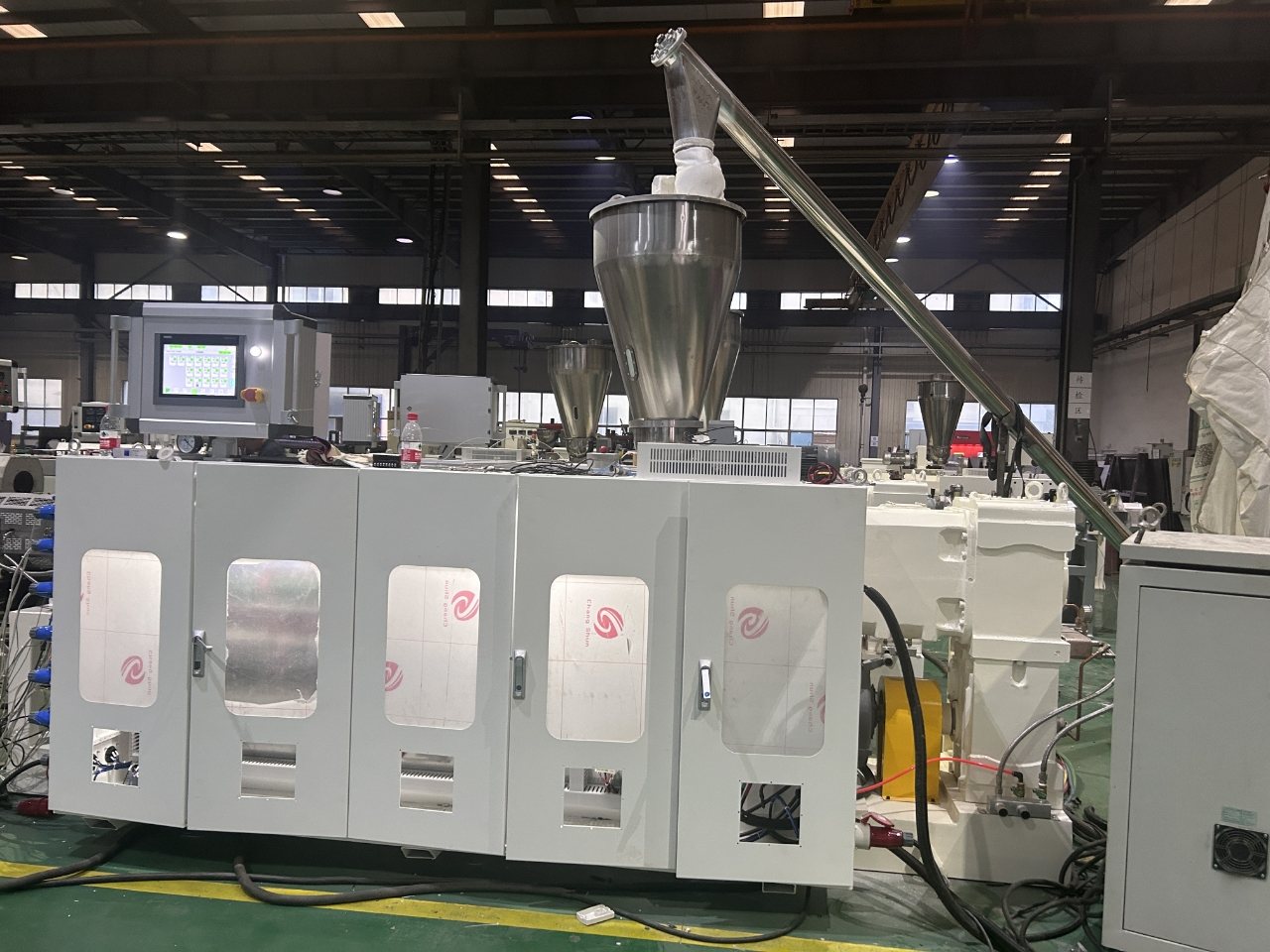
A high-density WPC door board needs enough material in the right places, but simply adding filler is not a reliable way to reach the target. The compound still has to plasticise evenly, fill the die without stagnant areas and cool without pulling the panel out of shape.
This page looks at the production issues behind density variation. It is written for buyers who have already chosen WPC as a door material and now need a line that can repeat a specification, not just produce a heavy sample.

Why density changes from board to board
Wood powder absorbs moisture differently from PVC resin and mineral filler. If the material is not dried or vented consistently, gas and moisture can disturb the melt. The result may show up as small surface defects, internal voids or a change in board weight.
Screw speed, barrel temperature and die pressure also interact. A higher output setting can look efficient while the melt temperature climbs and the calibration section struggles to remove heat. The line then produces more boards, but the reject rate can rise just as quickly.
- Moisture variation in wood powder
- Poor dispersion of filler or additives
- Unstable vacuum at the calibration table
- Cooling water temperature that changes during the shift
- Haul-off speed changed without adjusting the upstream settings
The parts of the line that create a stable result
The extruder needs a screw and barrel combination that matches the PVC-rich WPC compound. The die needs balanced flow across a wide, thick section. The calibration table needs enough vacuum zones and water contact to cool the board gradually, and the haul-off needs enough force to move it without distorting the edges.
A density-controlled line is therefore a system. The best way to evaluate it is to run the same formula at the intended production speed and check weight, thickness and flatness at several points across the board. A single hand sample is not enough evidence.
How BENK supports the density target
BENK can specify the line with a bi-metallic screw and barrel, a cast-aluminium heater set with stainless cover, a Siemens AC motor and an ABB inverter in the reference configuration. Those component choices support stable running, but the more important work is matching screw geometry, die flow and cooling to the product.
Before quotation, BENK reviews the panel size, material formula, target output and available factory utilities. If the buyer has an existing compound, a trial plan should be agreed so density, surface and dimensional checks use the same method from the first run.
- Screw and barrel selected for the WPC formulation
- Die and calibrator reviewed as one flow system
- Temperature and vacuum zones set for gradual cooling
- Haul-off speed and force sized for the panel section
- A documented trial routine for weight, thickness and flatness
Production sequence
From material preparation to finished panel
- 01
Receive and check raw materials
Record wood powder moisture, filler grade and PVC batch before mixing.
- 02
Mix to the approved formula
Use a repeatable weighing and mixing sequence instead of adjusting by eye.
- 03
Set the extrusion window
Establish barrel temperatures and screw speed around the intended output.
- 04
Balance die flow
Check melt distribution across the full panel width.
- 05
Calibrate and cool
Hold dimensions while removing heat at a controlled rate.
- 06
Measure the board
Check weight, thickness, width and flatness at the start, middle and end of the run.
- 07
Lock the proven settings
Record the approved setup for the next production batch.
Reference window
Reference specification and planning range
The figures below are a starting point for discussion. The final line specification should follow the approved panel drawing, material formula and trial result.
| Item | Reference / planning note |
|---|---|
| Reference output | 350-800 kg/h depending on panel width and extruder selection |
| Screw and barrel | Bi-metallic configuration available |
| Drive and control | Siemens AC motor and ABB inverter in the BENK reference build |
| Heating | Cast-aluminium heaters with stainless steel covers |
| Calibration | Six-metre vacuum table in the reference line |
| Density control | Confirmed through formula, die balance and measured board samples |
How BENK fits the project
Where the BENK line supports the result
BENK can build a high-density WPC door board line around a confirmed formulation and output target. We avoid promising a density figure without a material trial, because the screw, die, cooling and raw-material batch all affect the result.
Buyer checklist
What to settle before you compare quotations
- Ask the supplier to define how density will be measured and sampled.
- Run a trial with the real wood powder and PVC compound, not a generic laboratory blend.
- Check board weight at both edges and the centre of the panel.
- Record cooling water temperature during the trial.
- Compare flatness after 24 hours, not only immediately after cutting.
Questions buyers ask
WPC door panel line FAQ
Can a WPC door board line guarantee a specific density?
No responsible supplier should guarantee density without knowing the formula and test method. BENK can define the machine window and trial procedure, then verify the result with the buyer's material.
Does higher output always mean lower density?
Not automatically, but output and density interact. The screw, die and cooling section have to be sized together so faster running does not create voids or internal stress.
Why does a board change weight during production?
Common causes include moisture variation, inconsistent feeding, drifting melt pressure or a change in haul-off speed. The line data should be recorded so the cause can be isolated.
Can the same extruder run door boards and profiles?
It may be possible with compatible screw, die and downstream equipment. The changeover and power use should be assessed for the actual product mix.
Project brief
Tell us the panel, not just the machine.
Send the panel drawing, material formula, target output and factory location. BENK can then review the line configuration against the actual product.