
WDP-01 · Solid-core production guide
Solid WPC Door Panel Production Line: Getting Density, Flatness and Output in Balance
A solid WPC door board is judged after it has cooled, been cut and sat in storage. If the edges are straight, the faces are flat and the weight is consistent from the first board to the last, the line is doing its job.
Technical review: BENK Machinery · Updated 6 November 2026
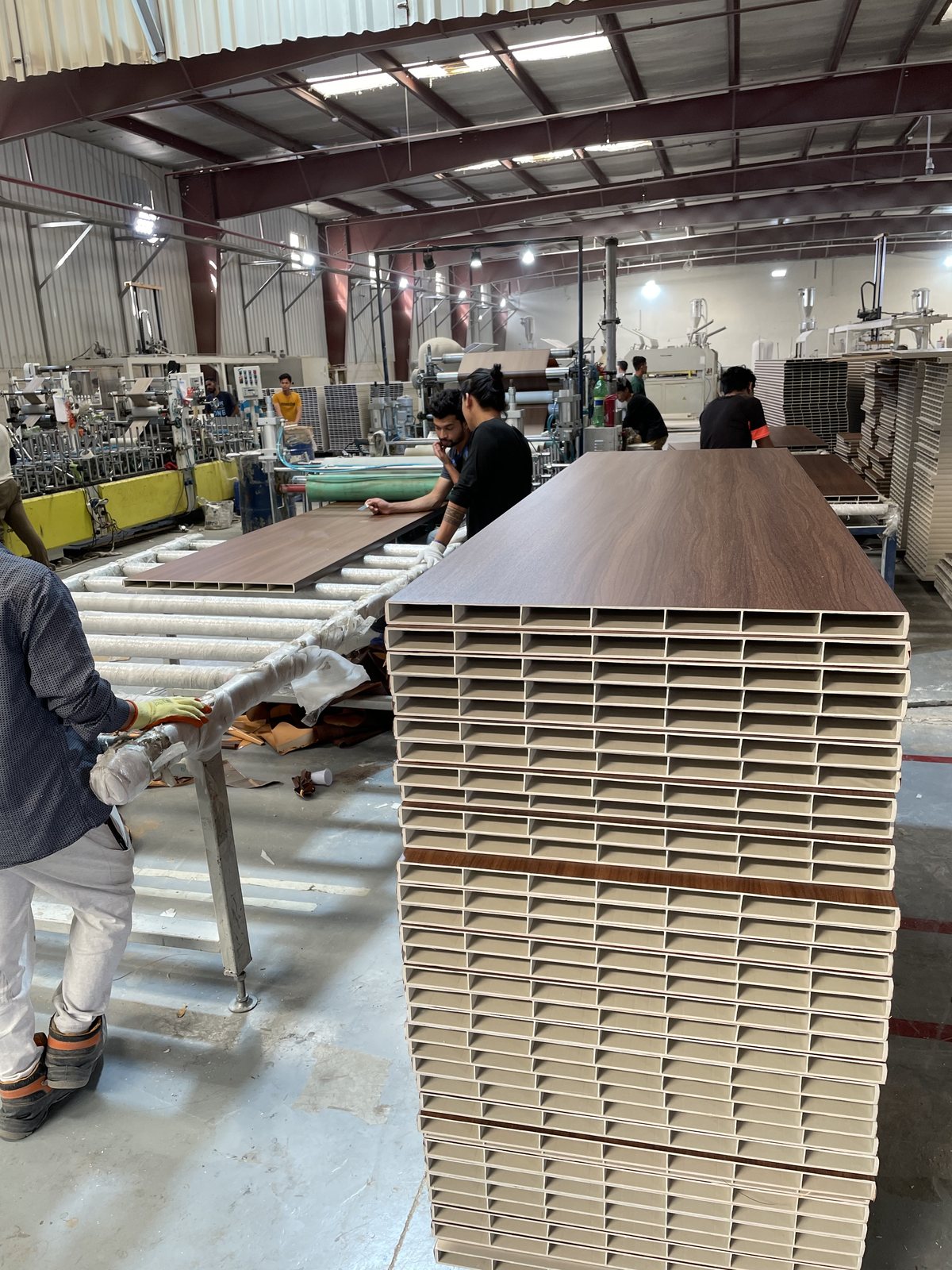
Solid WPC door panels are often described by their finished appearance, but the production result starts much earlier. Feed consistency, screw plasticising, melt pressure, die balance and cooling all leave a mark on the final board. When one of those variables moves, the problem usually appears later as bowing, uneven density, rough edges or inconsistent screw holding.
For a new line, the useful question is not simply how wide the extruder is. It is whether the whole line can hold the same board structure across a full shift, after a die change and with the raw materials the factory can actually buy. That is the basis on which BENK configures a solid WPC door panel production line.
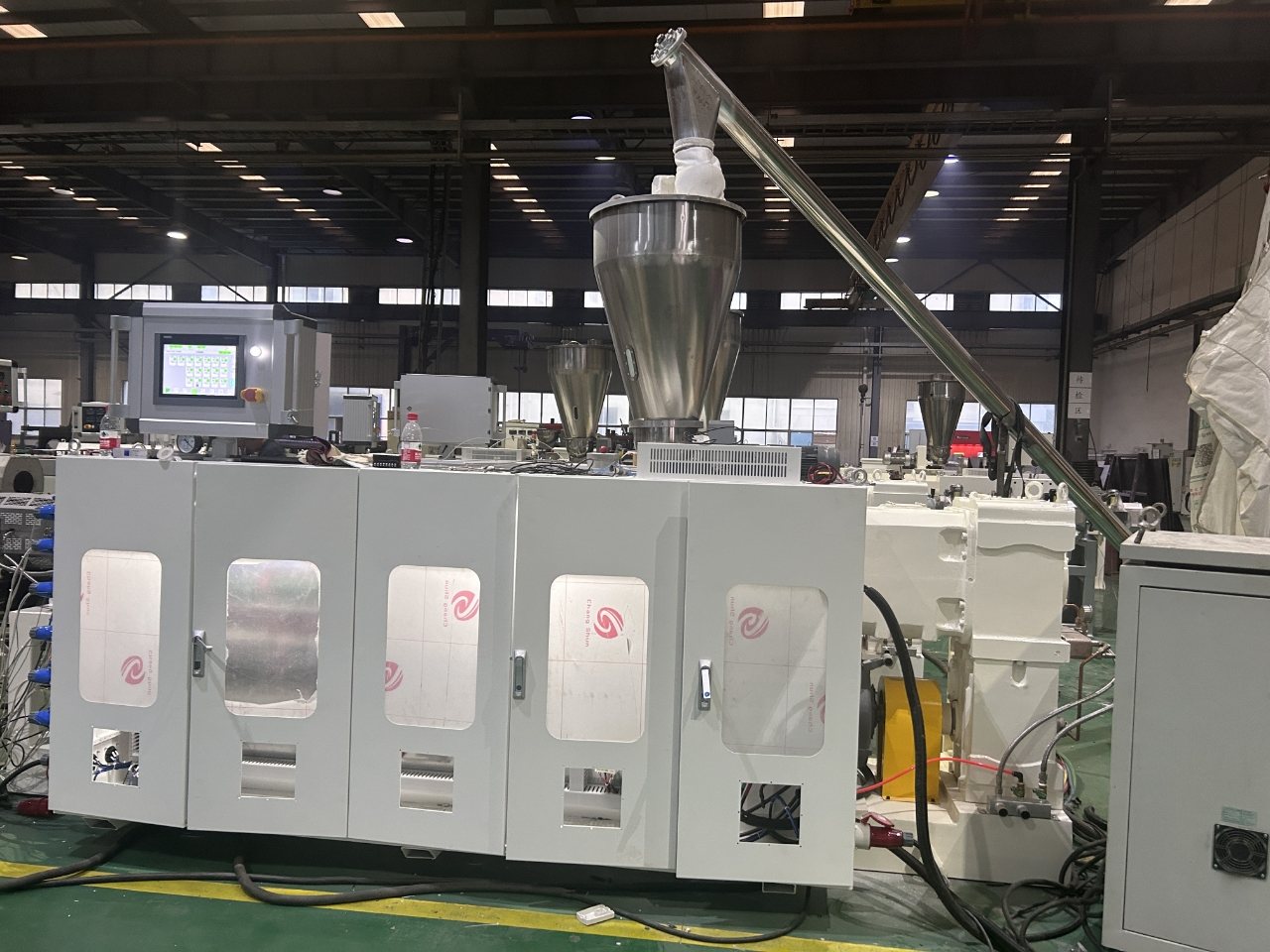
Where solid door boards tend to lose consistency
The first risk sits in the blend. Wood powder, PVC powder, calcium carbonate and additives do not behave the same way when moisture or particle size changes. A line that runs well on one batch may show unstable pressure on the next if the feeding and venting setup has little margin.
The second risk is cooling. A thick solid profile carries heat into the centre of the board. If the outside hardens faster than the core, internal stress can remain in the panel. The board may look acceptable on the run-out table and reveal a slight bow only after cutting or a few days in storage.
- Melt pressure that drifts during the run
- Uneven thickness across the panel width
- Visible pull marks or rough edges
- Bowing after cooling or stacking
- Density differences between the centre and edges
What the extrusion line has to control
A solid WPC door panel line needs a stable plasticising section, a die that distributes melt evenly across the full width and a calibration table that supports the board while it cools. The haul-off and cutter then have to match the line speed without introducing extra stress at the end of the process.
For door boards in the 40-50 mm range, small differences in die temperature and vacuum settings can be visible on the finished face. That is why the machine order, the support rollers and the cooling length should be reviewed together rather than treated as separate purchases.
How BENK builds the configuration around the panel
BENK starts with the board size, target output and material formula. From there, the line can be built around a conical twin-screw extruder, a door-board die, a six-metre vacuum table, a width-matched haul-off and a cutting and stacking section. Standard reference models cover 600, 800, 900 and 1000 mm panel widths.
The aim is not to sell the largest machine on the list. It is to give the factory enough melt capacity, cooling length and pulling force for the selected board without making changeovers unnecessarily difficult. Where the product mix includes several widths or thicknesses, the die and downstream setup should be discussed at the quotation stage.
- Reference output from 350-400 kg/h for the YF600 configuration and 600-800 kg/h for wider models
- SJZ80/156 or SJZ92/188 extruder options according to width and capacity
- Six-metre vacuum calibration table for thick door boards
- Haul-off force and speed matched to the board section
- Cutting and stacking arranged around the actual panel length
Production sequence
From material preparation to finished panel
- 01
Material preparation
Wood powder, PVC and fillers are weighed and mixed to a formula the line can repeat.
- 02
Plasticising
The conical twin-screw extruder heats and mixes the compound under controlled pressure.
- 03
Die forming
The door-board die distributes melt across the panel width and forms the internal section.
- 04
Calibration
Vacuum and water cooling hold the outside dimensions while the board continues to cool.
- 05
Haul-off
A width-matched puller moves the board at a steady speed without marking the surface.
- 06
Cutting
The cutter produces the required panel length after the profile has stabilised.
- 07
Stacking and inspection
Finished boards are checked for flatness, dimensions and surface condition before packing.
Reference window
Reference specification and planning range
The figures below are a starting point for discussion. The final line specification should follow the approved panel drawing, material formula and trial result.
| Item | Reference / planning note |
|---|---|
| Reference widths | 600 / 800 / 900 / 1000 mm; other widths depend on die and downstream design |
| Reference thickness | Commonly 40-50 mm for WPC door boards; confirm with the intended product |
| Extruder options | SJZ80/156 or SJZ92/188 according to output and panel width |
| Output reference | Approx. 350-400 kg/h for YF600; approx. 600-800 kg/h for YF800-YF1000 |
| Cooling and calibration | Six-metre vacuum table in the reference configuration |
| Quality checks | Width, thickness, flatness, surface, edge condition and sample density |
How BENK fits the project
Where the BENK line supports the result
BENK can configure the solid WPC door panel line around the target width, thickness and output. Final performance depends on the approved formula, die, cooling setup and product trial, so the specification should be confirmed with samples rather than assumed from a model number alone.
Buyer checklist
What to settle before you compare quotations
- Ask for a die flow study for the exact panel width, not only a general machine drawing.
- Confirm whether the cooling table length suits the thickest board you plan to make.
- Send samples of the wood powder and PVC compound before the final line specification.
- Agree on the test method for flatness and density before shipment.
- Plan storage support for thick panels so the line result is not lost after production.
Questions buyers ask
WPC door panel line FAQ
What width can a solid WPC door panel line produce?
BENK reference models cover 600, 800, 900 and 1000 mm widths. Other widths can be reviewed, but the die, vacuum table, haul-off and cutter need to be matched to the final panel.
Is a conical twin-screw extruder suitable for WPC door boards?
It is a common choice for PVC-rich WPC compounds because it provides good mixing and pressure stability. The screw configuration and venting still need to suit the actual formula.
How do you control flatness after extrusion?
Flatness comes from the combined effect of die balance, uniform cooling, support through the calibration table and controlled haul-off. It cannot be corrected reliably by one downstream adjustment alone.
Can the same line run more than one panel size?
Yes, if the die and downstream equipment are designed for changeovers. The practical range and changeover time should be agreed before the order.
Project brief
Tell us the panel, not just the machine.
Send the panel drawing, material formula, target output and factory location. BENK can then review the line configuration against the actual product.