WDP-10 · Recycled material
Recycled WPC Door Panel Production Line: Design for Variation Before You Promise the Saving
Recycled material can lower raw-material cost and support a stronger environmental story. It can also bring moisture, contamination and batch variation into a process that already has little tolerance for drift.
Technical review: BENK Machinery · Updated 6 November 2026

WPC already has a practical recycling story because it can use wood waste and some recovered PVC. That does not mean every recycled stream belongs in a door panel. The source, cleanliness and consistency of the material decide whether the line can run it profitably.
This page looks at the production controls a recycled WPC door panel line needs. It is aimed at factories that want to use recovered material without turning the board into a batch-by-batch experiment.
What recycled material changes on the line
Post-industrial PVC may contain colour, filler or additive residues. Wood waste may carry moisture or different particle sizes. If those differences are not controlled, the melt can change pressure, colour and cooling behaviour without any adjustment to the machine settings.
Contamination can also damage the die or leave visible specks on the face. The preparation stage therefore matters as much as the extruder. Sorting, grinding, drying and filtration should be designed for the actual waste stream.
- Moisture variation from wood waste
- Colour and filler variation in recovered PVC
- Metal or hard-particle contamination
- Inconsistent particle size
- Weak batch traceability
Building a stable recycled formula
A practical formula should specify the acceptable percentage of recycled material and the properties that must stay within range. The production team then needs a batch record: source, moisture, bulk density, colour and any additive adjustment.
The line should have enough venting and filtration for the selected stream. A conical twin-screw extruder can provide good mixing, but it cannot correct a contaminated batch. The die and calibration section also need a stable melt pressure to keep the panel dimensions consistent.
How BENK approaches recycled WPC projects
BENK reviews the recycled stream before recommending the line. The discussion covers the source, preparation method, target replacement ratio and quality checks. Where required, material drying, metal separation and filtration can be planned with the wider process.
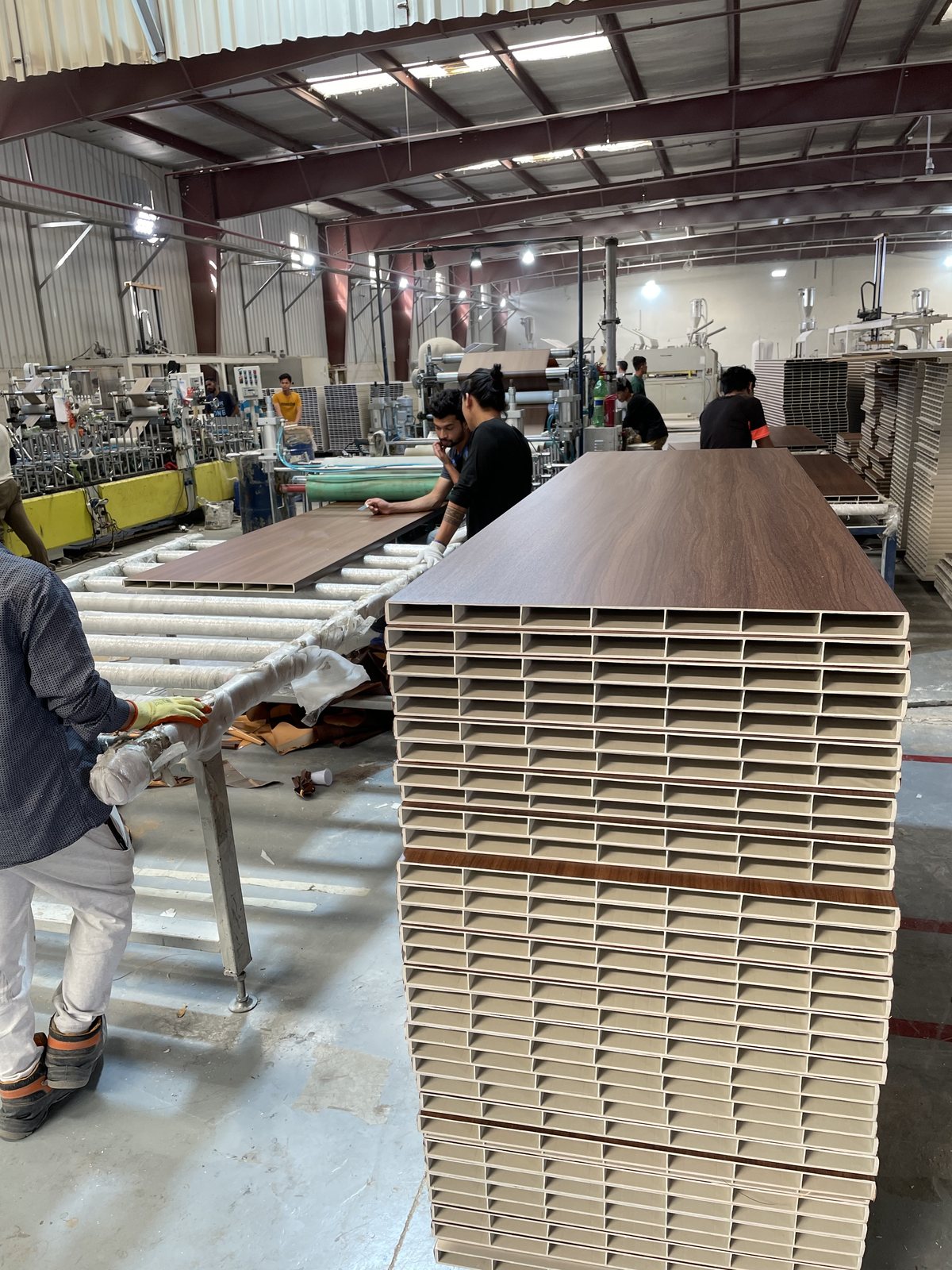
The door-board line itself can use the reference extruder, die, six-metre vacuum table and matched haul-off. The trial should run with the actual recycled batch at the intended ratio, then compare the board against a virgin-material reference.
- Material preparation reviewed before machine selection
- Venting and filtration planned for the waste stream
- Reference batch run with the real recycled material
- Colour and surface compared with the approved standard
- A clear percentage limit for each product family
Production sequence
From material preparation to finished panel
- 01
Characterise the waste
Record source, moisture, contamination and particle size.
- 02
Prepare the material
Sort, grind, dry and filter as required.
- 03
Set the replacement ratio
Define the approved recycled percentage for the product.
- 04
Adjust the formula
Review lubricants, stabilisers and filler balance.
- 05
Run the production trial
Check pressure, output and surface stability.
- 06
Compare the board
Assess colour, density, flatness and edge quality against the reference.
- 07
Lock the batch record
Keep material and process data with the approved sample.
Reference window
Reference specification and planning range
The figures below are a starting point for discussion. The final line specification should follow the approved panel drawing, material formula and trial result.
| Item | Reference / planning note |
|---|---|
| Recycled content | Defined by source, quality and product target; not a universal figure |
| Material preparation | Sorting, grinding, drying and filtration as required |
| Extruder | WPC screw and barrel configuration reviewed for the stream |
| Venting | Set according to moisture and volatile content |
| Panel range | Reference 600-1000 mm width and 40-50 mm thickness for door boards |
| Quality control | Batch records, colour check, surface check and dimensional checks |
How BENK fits the project
Where the BENK line supports the result
BENK can review a recycled WPC door panel line around the buyer's actual waste stream. The final scope depends on material preparation and the approved replacement ratio, so a production sample should be tested before the line specification is fixed.
Buyer checklist
What to settle before you compare quotations
- Ask the recycler for a consistent material specification, not a single sample.
- Test moisture and contamination before the machine trial.
- Agree on the maximum recycled percentage for each product.
- Check the cut edge for specks and voids.
- Keep a virgin-material reference board for comparison.
Questions buyers ask
WPC door panel line FAQ
Can a WPC door panel use 100% recycled material?
That is rarely a simple answer. The source and quality of the recycled stream determine how much can be used while maintaining appearance and dimensional stability.
Which recycled materials are most practical?
Clean post-industrial PVC and well-sorted wood waste are easier to control than mixed post-consumer streams. The material should be characterised before specification.
Does recycled material reduce output?
It can, especially if filtration or extra venting is needed. The practical output should be confirmed with the actual batch.
How do you control colour variation?
Use a defined source, batch records and an approved colour range. Pigment adjustment may be needed, but it should not hide contamination.
Project brief
Tell us the panel, not just the machine.
Send the panel drawing, material formula, target output and factory location. BENK can then review the line configuration against the actual product.