
Project Overview
WPC door panels have become an important product category in interior doors, door-frame systems, custom furniture and integrated wall-door-cabinet applications. A typical wood-plastic composite door panel uses PVC resin as the polymer matrix, combined with activated calcium carbonate, stabilizers, processing aids, lubricants, impact modifiers and other functional components. The material is processed through mixing, extrusion, calibration, cooling, haul-off, cutting and stacking to form a continuous hollow or foamed profile.
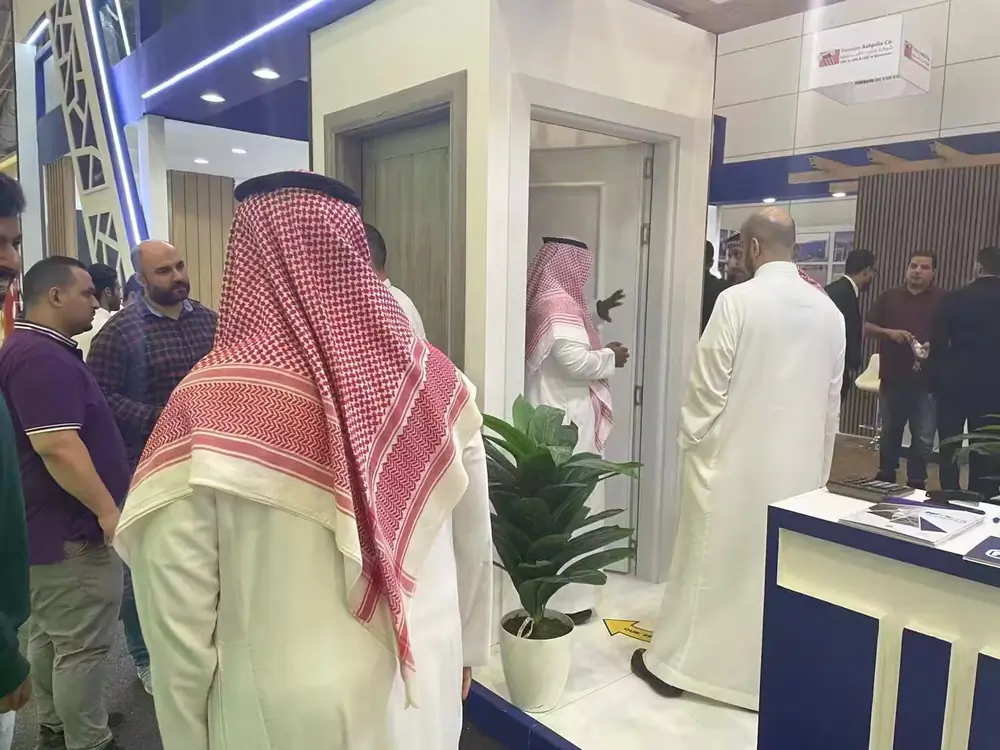
This project focuses on a WPC door panel and matching door frame production line. BENK reviewed the customer’s product structure, raw material concept and target production requirements, then matched the mixer, extruder, die, calibration system, haul-off unit, cutting equipment and stacking system as an integrated line. The formulation and process were verified through trial production to improve the stability of continuous operation.
Project Requirements and Technical Challenges
A WPC door panel project is more than a simple PVC extrusion application. For a finished door panel, the production line must deliver consistent surface quality, accurate dimensions, stable mechanical properties and efficient material usage.
The main challenges usually include:
- Surface quality: stripes, bubbles, sink marks, color variation and flow marks must be controlled.
- Internal structure: the panel must balance stiffness, weight, dimensions and material consumption.
- Formulation adaptability: PVC resin, calcium carbonate, stabilizers, lubricants, processing aids and wood-plastic components must work together.
- Continuous production stability: mixing accuracy, barrel temperature, vacuum calibration, haul-off speed and cutting synchronization all affect product consistency.
- Profile compatibility: door frames, architraves and decorative profiles may need to be produced on the same line or compatible equipment.
- Downstream processing: film lamination, transfer printing, coating, slotting, lock-hole machining and hardware installation require a flat and dimensionally stable substrate.
For these reasons, a WPC door panel production line must be designed as a complete process system rather than a collection of separate machines.
BENK’s Complete WPC Door Panel Production Solution
BENK provides customized WPC door panel, door board and door frame production lines covering material mixing, extrusion, calibration, cooling, haul-off, cutting and stacking.
1. High-Speed Mixing and Material Preparation
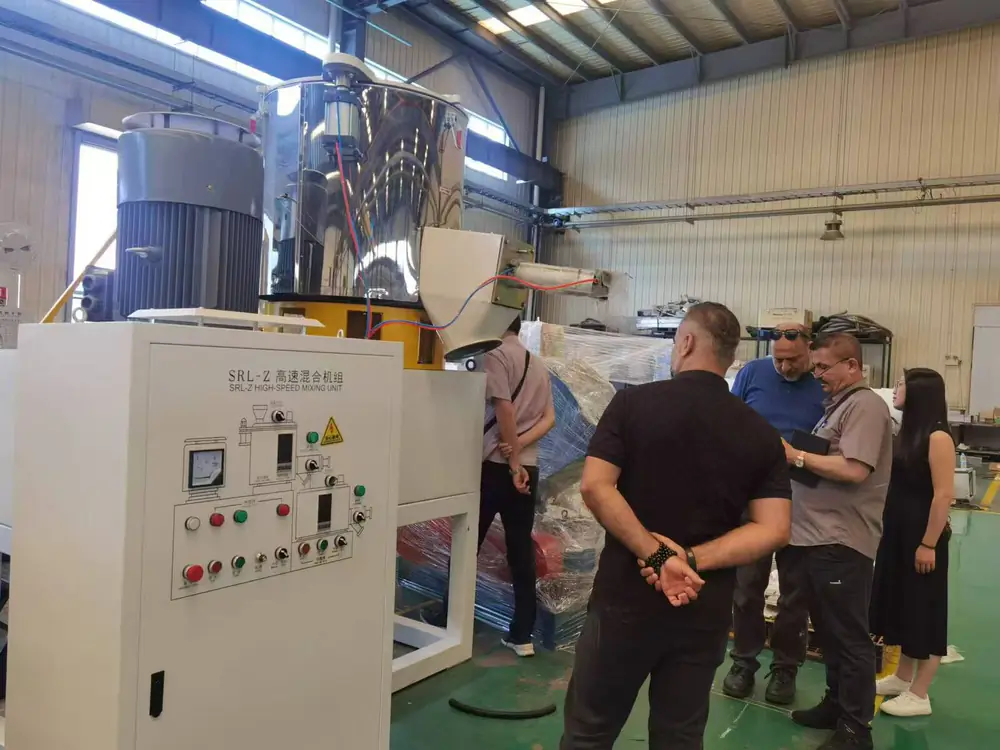
PVC resin, calcium carbonate, stabilizers, lubricants and processing aids must be evenly dispersed before extrusion. A high-speed mixer and cooling mixer improve batch consistency and reduce surface defects or process fluctuations caused by uneven formulation.
2. Conical Twin-Screw Extruder
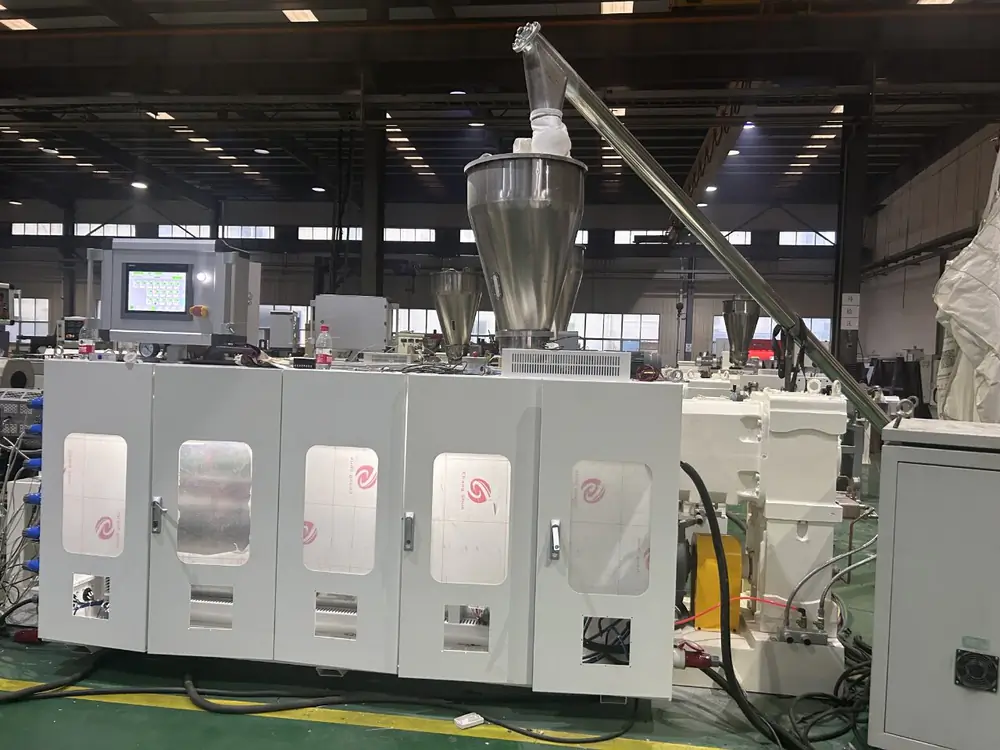
Conical twin-screw extruders are widely used for PVC and WPC door panels, door frames and profiles because of their controlled mixing, plastification and low-pressure conveying characteristics. Screw geometry, temperature zones and vacuum venting can be optimized to improve melt quality and reduce unnecessary shear heat.
3. Door Panel and Door Frame Dies
The extrusion die determines the cross-section, wall thickness, internal cavities and outer dimensions of the WPC door panel. For different panel widths, thicknesses and surface requirements, the die flow channels must be designed to distribute the melt evenly.
Matching door frame and decorative profile dies can also be supplied for multi-product production.
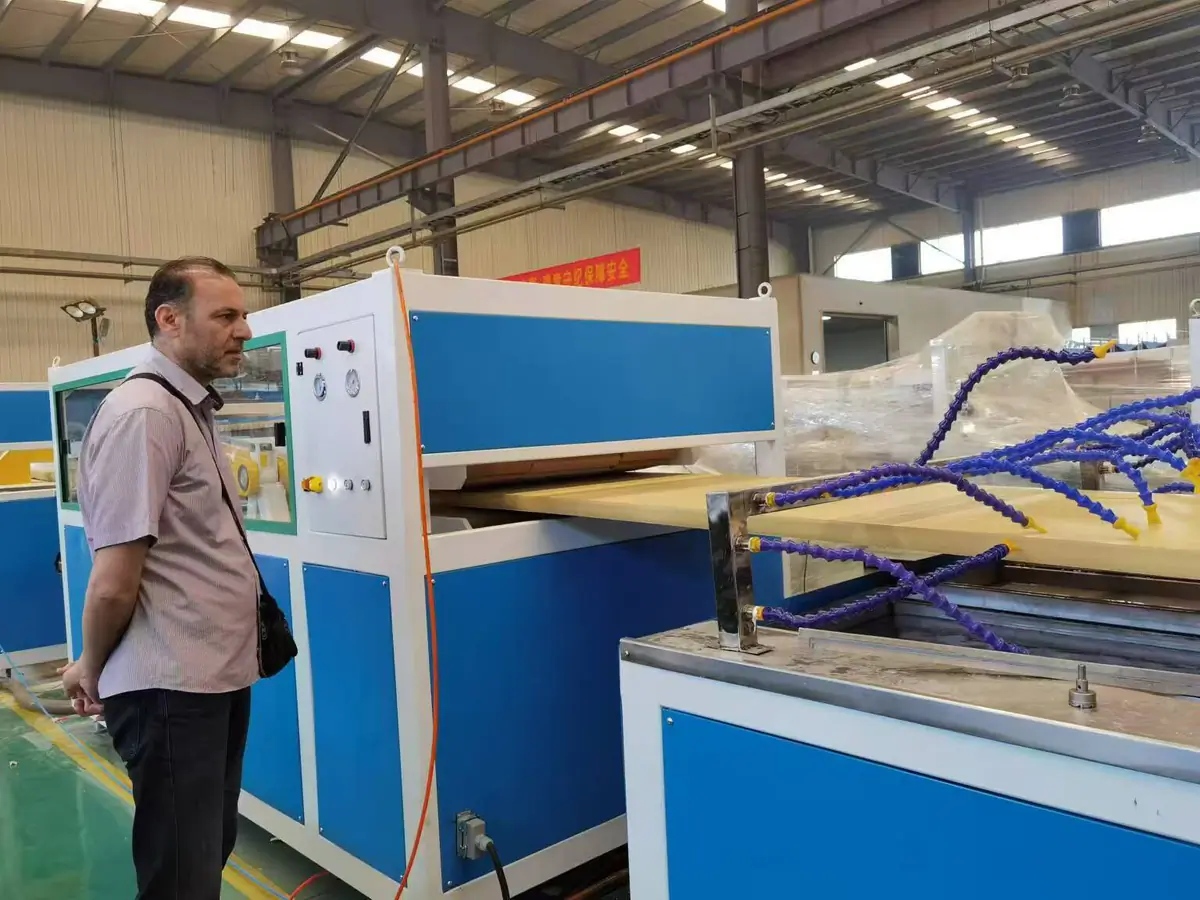
4. Vacuum Calibration and Cooling
After leaving the die, the WPC door panel enters the calibration die and water tank. Vacuum calibration pulls the outer surface against the calibrator to control cross-section dimensions, straightness and surface flatness. Cooling speed and vacuum level must match the haul-off speed to avoid internal stress, uneven shrinkage or dimensional variation.
5. Haul-Off and Cutting
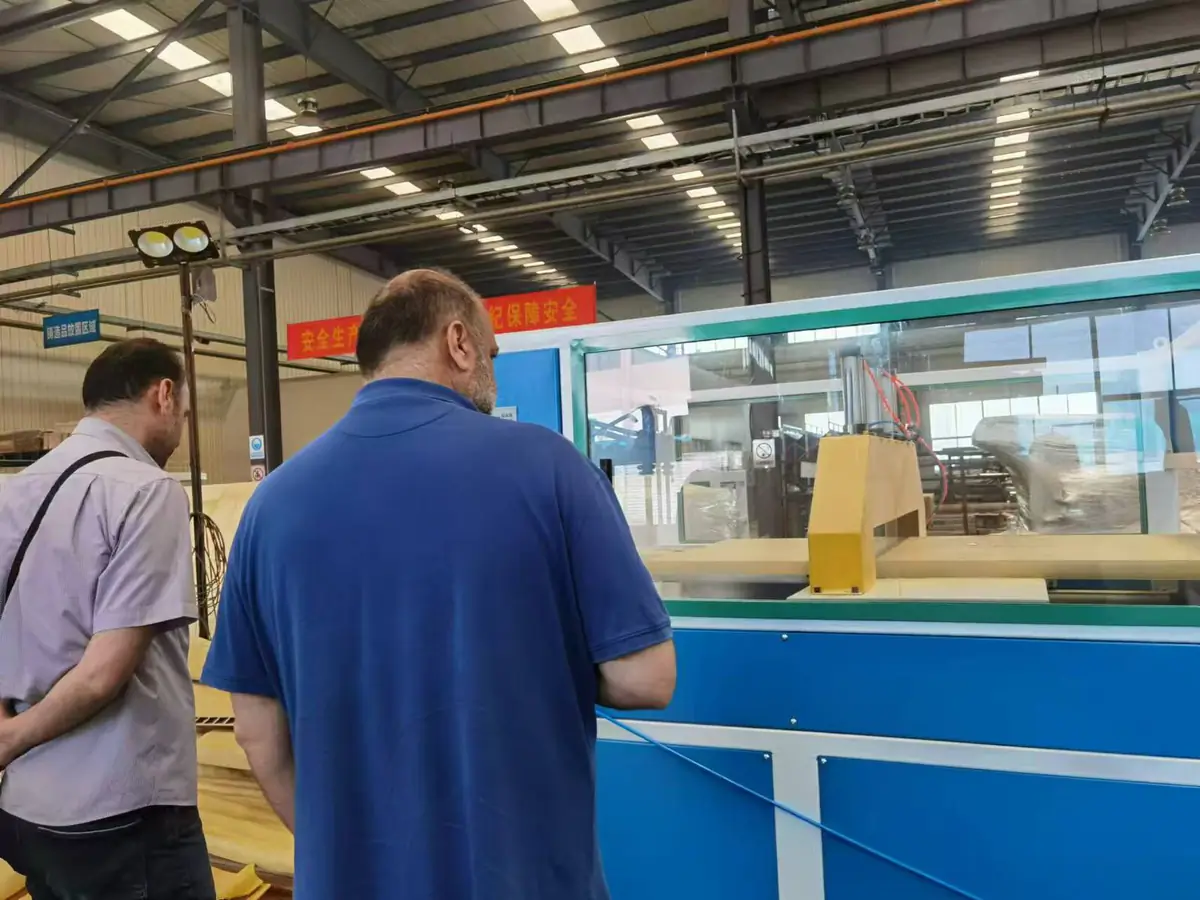
A caterpillar haul-off unit provides stable pulling force. Its speed must remain synchronized with extrusion, calibration and cutting. For wide door panels, pressure distribution and synchronization directly influence surface quality and dimensional stability.
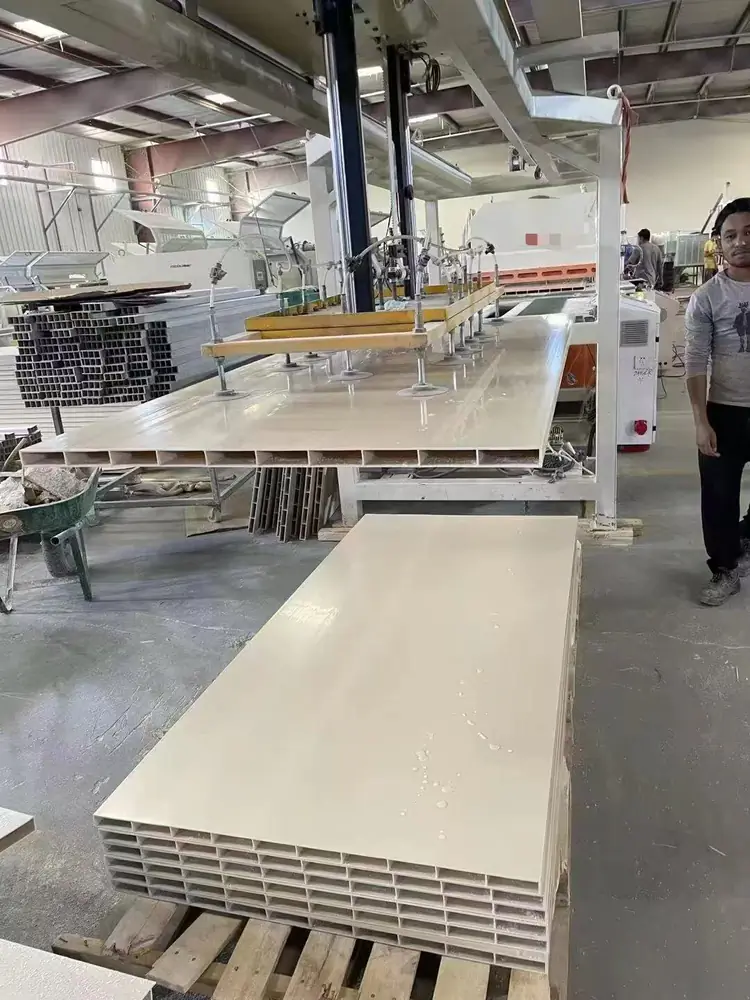
6. Lifting and Automatic Stacking
WPC door panels are long and relatively heavy. Manual handling can cause surface scratches and damage. A lifting and stacking system reduces labor intensity, improves line efficiency and protects the finished panel surface.
WPC Door Panel Formulation Knowledge
A WPC door panel formulation generally includes the following functional components:
- PVC resin: the polymer matrix that determines basic strength, processing behavior and surface quality.
- Activated calcium carbonate: improves rigidity and dimensional stability and can reduce cost, but excessive loading may reduce impact strength and surface quality.
- Heat stabilizer: protects PVC from thermal degradation during extrusion.
- Processing aid: improves plastification, melt strength and surface appearance.
- Internal and external lubricants: balance material flow, release and friction in the screw, die and calibrator.
- Impact modifier: improves low-temperature impact and corner strength.
- Foaming or lightweight components: reduce density and material consumption, but require uniform cell structure.
- Wood powder or wood-plastic components: improve wood-like appearance and environmental characteristics, but moisture and dispersion must be controlled.
Successful formulation development is not about increasing one component. It is about balancing plastification, flow, strength, surface quality and cost. During trial production, BENK adjusts temperature, vacuum, haul-off and cutting parameters together with the customer’s formulation and product cross-section.
Product Structure and Market Value
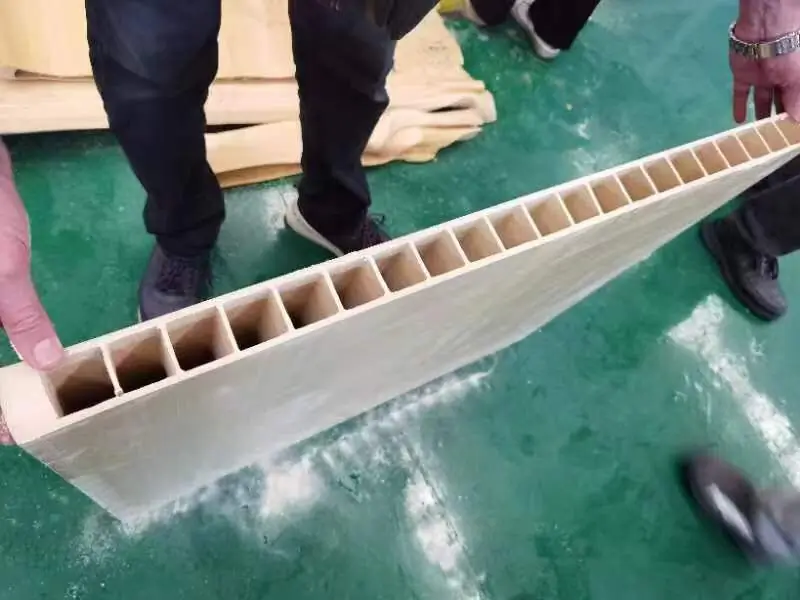
WPC door panels can be solid, foamed or hollow multi-cavity profiles. A hollow structure can reduce material consumption and finished weight while maintaining stiffness through a properly designed rib structure. This improves handling, transport and installation efficiency and can also support dimensional stability and acoustic performance.
Typical applications include:
- Interior doors, painted-free doors, composite doors and customized door panels
- Door frames, architraves, decorative profiles and edge profiles
- Wardrobe, cabinet and furniture decorative boards
- Wall panels, ceiling panels and space partitions
- Display cabinets, commercial interiors and modular construction
Compared with solid wood and some wood-based panels, WPC door panels offer moisture resistance, mildew resistance, reduced cracking, better dimensional stability, film laminating and transfer-printing capability, recyclability and a wood-like appearance.
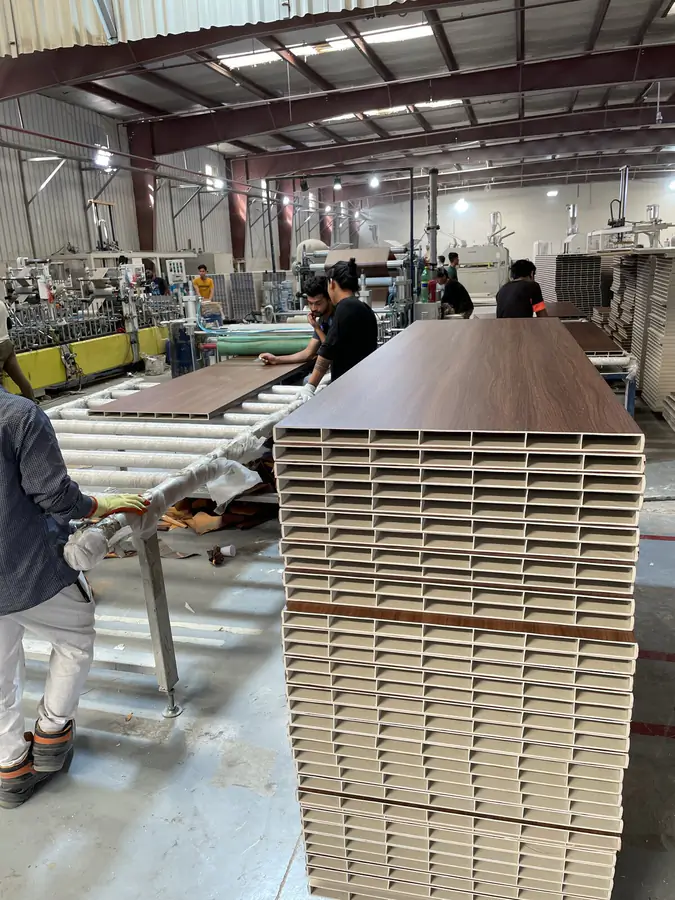
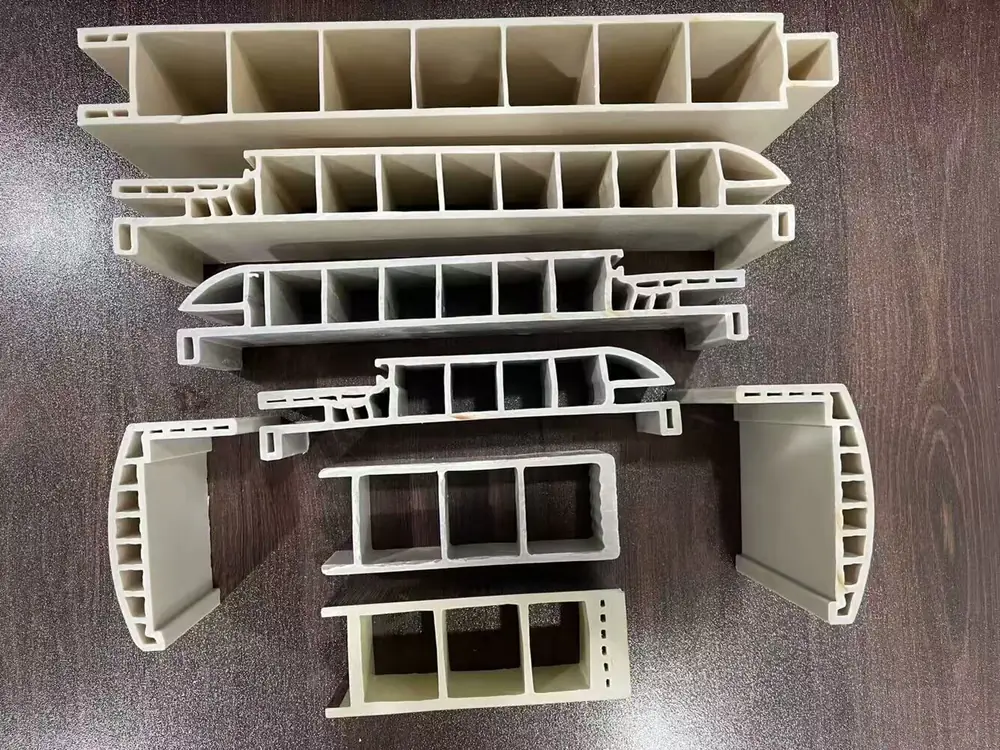
Batch Production and Customer Review
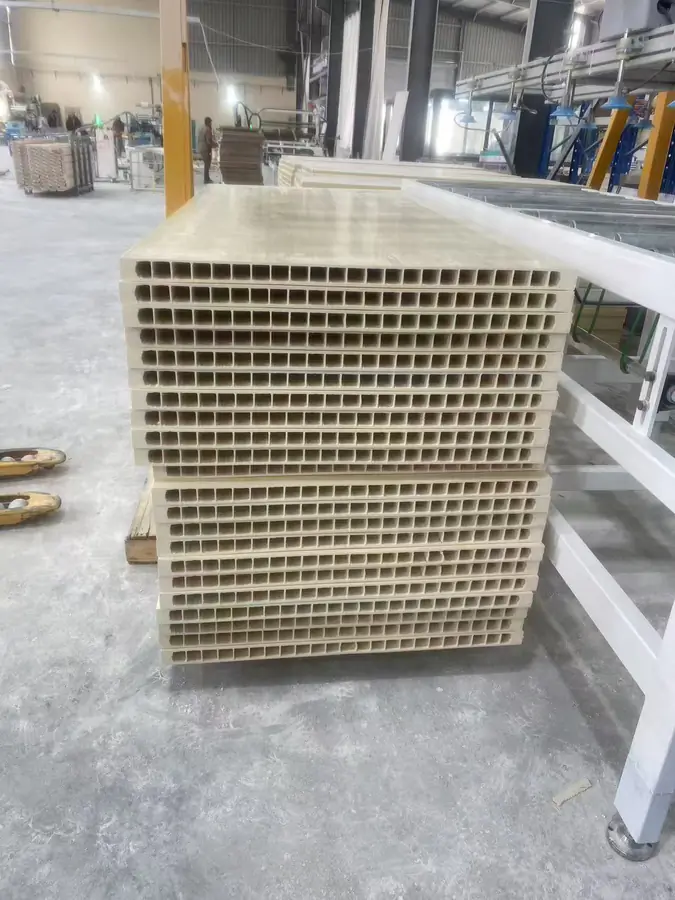
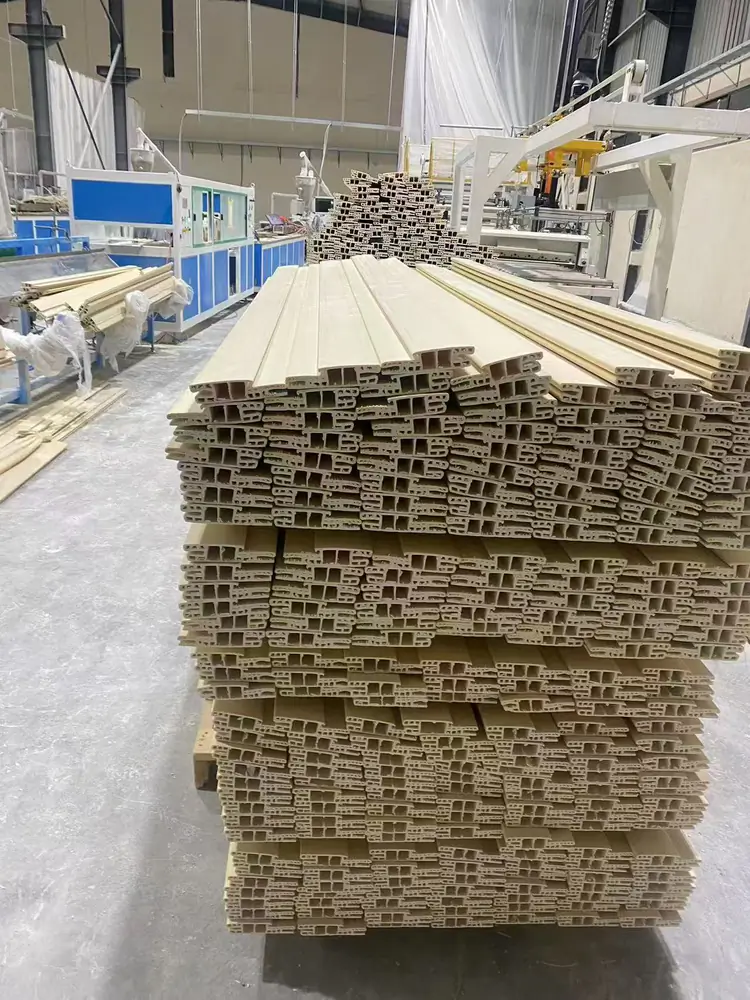
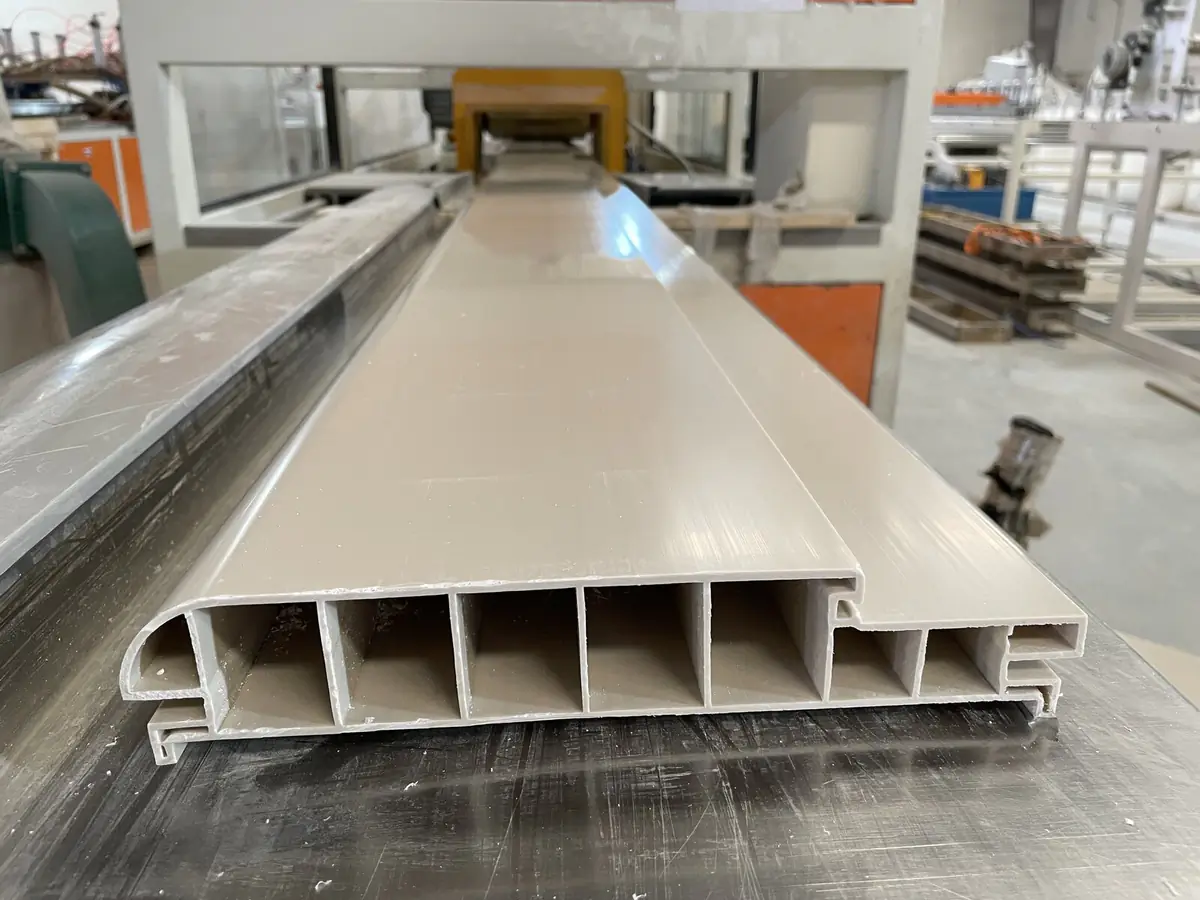
Trial Production and Process Control Points
Based on the project notes and production photos, the following points are critical during WPC door panel trial production and continuous operation:
- Raw material moisture and mixing uniformity.
- Balance between calcium carbonate, stabilizer and lubricant levels.
- Screw temperature, barrel vacuum and melt pressure.
- Die flow distribution and uniform die temperature.
- Matching vacuum calibration, cooling water temperature and haul-off speed.
- Cutting length, end-face quality and stacking cycle.
- Surface flatness, cleanliness and moisture control before film lamination.
It is recommended to keep batch formulation records, process parameter records and finished-product inspection records. These records help identify the cause of surface, dimensional or strength variation during production.
Why Choose BENK
BENK Machinery specializes in plastic extrusion equipment and complete production lines for WPC door panels, plastic profiles, plastic sheets, plastic boards, plastic pipes, plastic recycling and auxiliary equipment. For WPC door panel projects, BENK can support:
- Raw material and process route consultation
- Complete line design for extruder, die, calibration table, haul-off, cutter and stacker
- Factory trial production and formulation adjustment
- Factory layout and utility planning
- Overseas installation, commissioning and operator training
- Spare parts and ongoing technical support
If you are planning a WPC door panel production line, WPC door board extrusion line, PVC/WPC door frame production line, wood-plastic door panel machine, plastic profile extrusion line, WPC wall panel production line, WPC foam board machine, plastic extrusion line or plastic recycling and auxiliary equipment, BENK can provide a customized solution based on your material, product structure and target output.