RTP Engineering Guide
RTP Pipe Applications & Selection
RTP is not a single universal pipe. Its liner, reinforcement, jacket, pressure class and temperature rating must be selected together. This guide sets out the main application drivers and the information needed before a production line or pipe construction is specified.
Typical applications
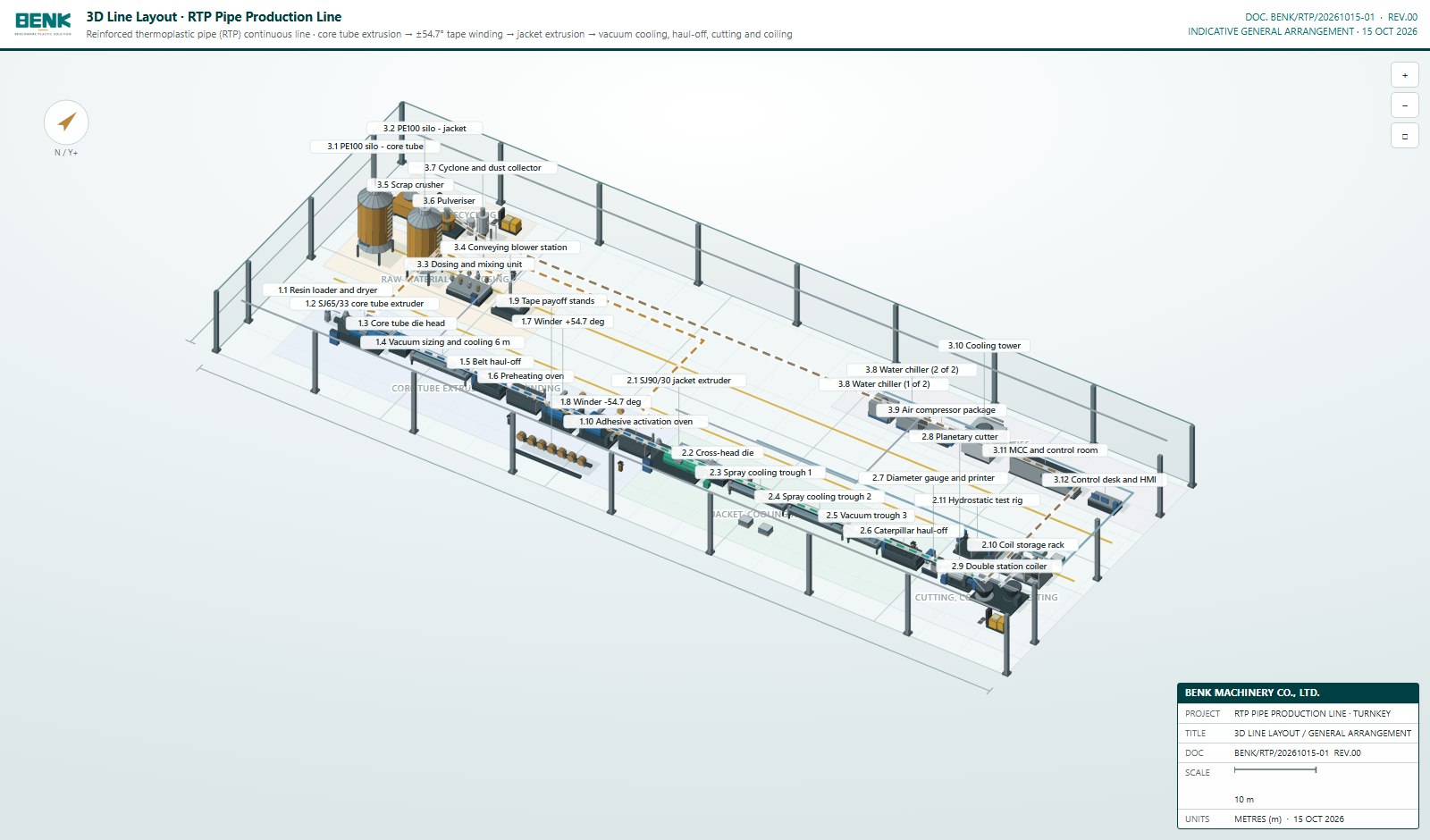
Application suitability must be confirmed for the actual fluid, concentration, temperature, pressure, permeation and external environment. A general RTP description is not a material compatibility approval.
Selection matrix
| Requirement | Main decision | Information to confirm |
|---|---|---|
| Fluid containment | Liner material and wall thickness | Chemical compatibility, permeation, temperature, pressure |
| Pressure resistance | Reinforcement type, layer count and winding angle | Design pressure, safety factor, cyclic or static duty |
| External protection | Jacket material and thickness | Abrasion, UV, moisture, chemicals, handling |
| Installation | Coil size, bend radius and jointing system | Route, equipment, trench or surface conditions |
| Qualification | Test and certification program | Project standard, test pressure, acceptance criteria |
RTP compared with steel and GRP
RTP is generally lighter and corrosion-resistant, and can be supplied in long coils. Steel remains preferable where very high temperature, fire performance, external impact or established codes demand it.
RTP uses thermoplastic materials and spoolable construction. GRP/FRP is normally thermoset and rigid. They are different products with different joining, testing and installation requirements.
RTP is an engineered pressure pipe with a defined reinforcement schedule and qualification basis, not a general-purpose hose. Bend radius and end connections remain design constraints.
What BENK needs to configure a line
- Pipe size matrix
- Design pressure and safety factor
- Operating and surge temperature
- Fluid and material compatibility
- Liner, reinforcement and jacket materials
- Reinforcement tape width and layer count
- Target output and line speed
- Coil size and handling limits
- Jointing and testing method
- Applicable qualification standard
Review the application before the equipment
Send the fluid, pressure, temperature, pipe size and project standard. We will help define the production scope and the information needed for a proper technical proposal.