RTP Line Service
RTP Line Upgrade & Retrofit
Existing RTP lines can often be improved without replacing every module. The practical route is to audit the current process, identify the bottleneck and then upgrade the winder, heating, jacket, cooling, haul-off, coiling or control system that limits quality, output or product range.
When an upgrade makes sense
Upgrade modules
| Module | Typical upgrade | What must be checked |
|---|---|---|
| Winding | Servo axes, tension control, guide system, recipe management, additional winding capacity | Pipe range, tape data, layer schedule, mechanical space and control compatibility |
| Heating and activation | Zone control, airflow, exhaust, temperature measurement, line-speed compensation | Material window, oven length, utility capacity and product temperature requirement |
| Jacket extrusion | Extruder, cross-head die, sizing, cooling and diameter feedback | Jacket material, output, pipe range and existing drive/control interface |
| Haul-off and cutting | Caterpillar haul-off, encoder synchronization, planetary cutter, cut-length control | Line speed, pipe stiffness, cut accuracy and downstream coiler interface |
| Coiling | Coil geometry, tension control, cutover, handling and packaging | Bend radius, coil weight, floor space and transport limits |
| Controls and quality | PLC/HMI, recipes, data logging, diameter gauge and traceability interface | Existing PLC brand, network, sensor availability and required records |
Retrofit process
Review layout, equipment list, PLC, drives, utilities, product range and current bottlenecks.
Compare current capability with the target pipe matrix, output and quality records.
Check mechanical space, utility capacity, control interface and shutdown plan.
Supply and integrate the selected modules with the existing line where technically feasible.
Dry run, material trials, recipe validation and operator handover after the upgrade.
New-line baseline for comparison
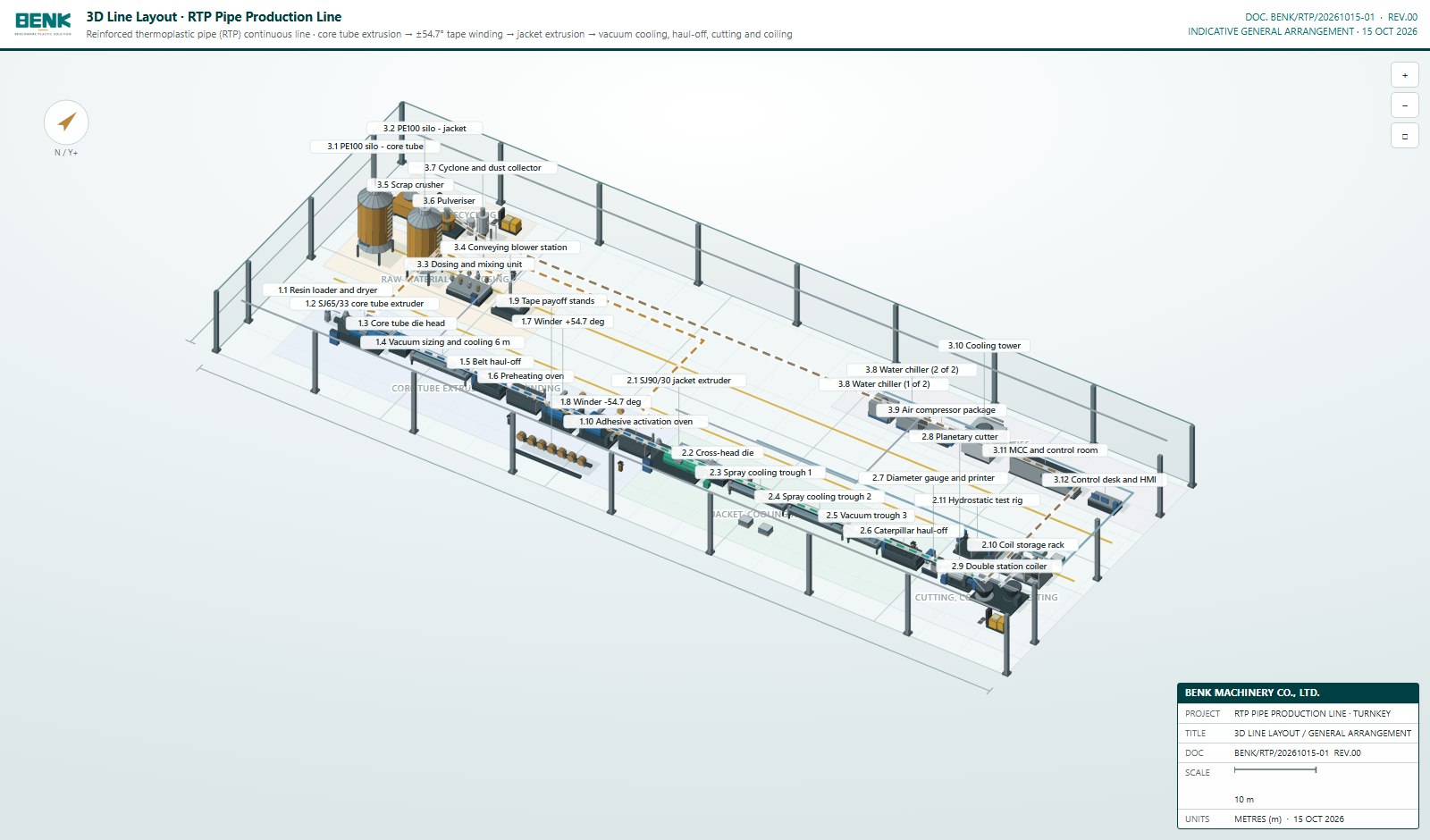
The confirmed BENK RTP line baseline is 50–200 mm ID / 63–250 mm OD, 1.6–6.4 MPa standard pressure, 120–350 kg/h, 0.5–8 m/min, 401.5 kW installed power and 33 equipment items / 34 machines. A retrofit does not automatically reach every value; the final scope depends on the existing equipment and utilities.
Start with the bottleneck, not a parts list
Send the existing line layout, equipment list, PLC brand, pipe range and target output. BENK will identify which modules can be upgraded and what must be replaced.