
PVC Twin-Wall & Hollow Roof Tile Production Line
This hollow roof sheet extrusion line produces twin-wall trapezoidal, wave and heat-insulating PVC roof tiles. The multi-cavity die, vacuum calibrator and cooling section are developed from the finished profile so the internal ribs fill correctly and the panel stays flat after cutting.
- Profile drawing review
- Werksabnahme
- Commissioning and operator training
- Updated 2026-11-19

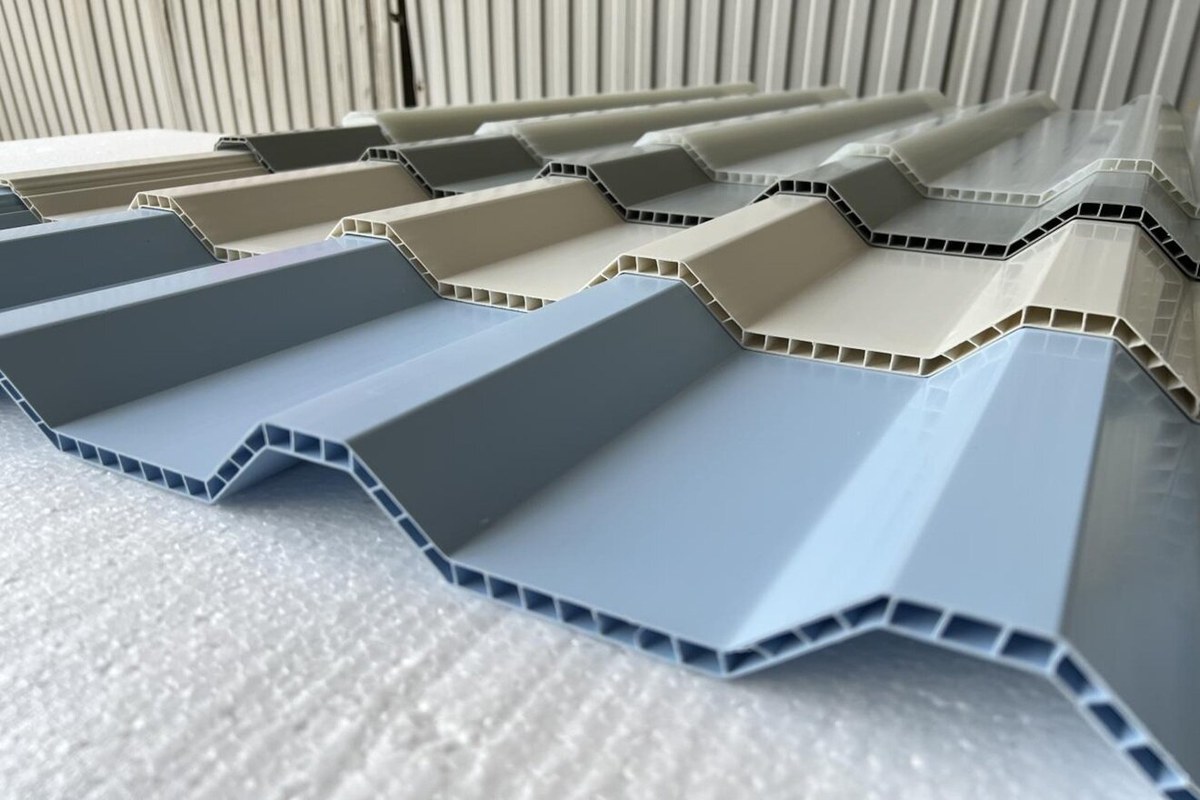
Representative product-family photo; final BENK line configuration may differ.
How the line matches your roof tile specification
Hollow roof tiles are chosen for stiffness, heat insulation, noise reduction and lower weight. The internal rib pattern creates much of that performance. If the ribs are thin, partly filled or poorly cooled, the panel may look acceptable outside but fail to deliver the expected strength.
The line usually combines a PVC substrate with an ASA surface layer. A multi-cavity die feeds the skin and internal walls, while a vacuum calibration sleeve sets the outside shape. Cooling channels, haul-off speed and cutter support all need to match the profile.
For solar roofs, review the tile profile together with the mounting rail, clamp position, load path and thermal movement. A PV-ready hollow roof sheet still needs project-level structural review. The tile profile alone is not a complete solar mounting system.
Buyers may use hollow roof tile manufacturing machine, twin wall plastic roof tile machine, PVC hollow roof sheet machine or heat insulation roof tile production line for this equipment. The die and calibration scope are more important than the label used by the supplier.
Typische Anwendungen
- Tropical and high-temperature roofing markets
- Agricultural greenhouses and livestock buildings
- Chemical, pharmaceutical and food factories
- Warehouses, sports facilities and schools
- Projects developing PV-integrated roof profiles
Roof profiles and tile formats
- Hollow trapezoidal tile
- Hollow wave tile
- Double-layer heat-insulation tile
- Hollow wall panel
- PV-compatible roof profile
- Custom multi-cavity profile
From PVC compound to packed roof tile
The line combines material preparation, extrusion, forming, cooling, cutting and inspection. The settings at each stage affect thickness, surface finish and scrap rate.
Compound preparation
PVC and additives are mixed to the approved formula; ASA is dried where required.
Substrate extrusion
A conical twin-screw extruder delivers a stable PVC melt for the hollow core.
ASA coextrusion
A separate extruder feeds the UV-resistant surface layer when specified.
Multi-cavity die
A balanced flow channel distributes material to the skin, ribs and internal walls.
Vakuumkalibrierung
The calibration sleeve sets the external profile and supports cavity formation.
Staged cooling
Special cooling runners and controlled water temperature stabilise rib fill and flatness.
Haul-off & cutting
Profile-matched haul-off and synchronous cutting maintain length and edge quality.
Inspection & stacking
Samples are checked for wall thickness, rib fill and surface quality before stacking.
How layer structure affects cost and weather resistance
The number of layers changes the extruder count, material cost, UV protection and the options for using reclaimed PVC.
PVC hollow core
A single-material hollow profile for applications where the surface protection and colour system are specified separately.
PVC / ASA surface
An ASA cap gives colour stability and UV protection while the PVC core provides the hollow structure and mechanical performance.
Multi-layer functional build
Colour, UV and functional layers can be separated when the application requires a broader warranty or a specific surface appearance.
PV-ready profile
The tile profile, rib layout, fixing zone and mounting accessories are developed as an assembly. Structural approval remains project-specific.
Typical PVC roof tile line specifications
Use these figures for preliminary planning. The quotation drawing and approved datasheet should replace every range with a confirmed value.
| Parameter | Typical project scope |
|---|---|
| Finished profiles | Hollow trapezoidal, wave, heat-insulation, wall-panel and custom multi-cavity profiles |
| Width and thickness | Quoted from the finished profile drawing; no universal width applies to all hollow profiles |
| Surface system | PVC or PVC/ASA coextrusion; colour and UV target confirmed at quotation |
| Die construction | Multi-cavity flow channel and distributor designed for the profile and output |
| Kalibrierung | Vacuum calibration sleeve with profile-specific cooling runners |
| Kühlung | Staged water cooling and temperature control to stabilise rib fill and flatness |
| Downstream | Profile-matched haul-off, synchronous cutter and stacker |
| Kontrolle | PLC and variable-frequency drives; temperature, vacuum and speed monitoring according to scope |
| Produktionsleistung | Confirmed by profile, wall thickness, number of cavities and formulation |
| PV option | Profile, fixing zone and mounting interface reviewed with the project engineer |
| Auxiliary scope | Ridge and accessory tooling; mixer, loader, crusher and pulverizer options |
| Dokumentation | Approved drawing, process settings, maintenance schedule and spare-parts list |
How to read this table: “Typical” means a common market configuration, not a guaranteed performance figure for every project. Output and thickness depend on the finished profile, formulation, layer ratio and cooling capacity.
What to check before you place an order
Compare the full production system, including the die, calibration, cooling, cutting and tooling package. A lower extruder price can lead to higher scrap or slower changeovers.
Rib fill
Cut a section and inspect every internal wall. Partial fill or voids reduce stiffness and may not be visible from the outer surface.
Wall thickness distribution
Measure skin and rib thickness at several points. A balanced die should hold the drawing tolerance around the full profile.
Calibration stability
Vacuum leakage, sleeve wear and cooling imbalance cause dimensional drift. Check access for cleaning and replacement.
Flatness after cutting
Hollow panels can move as internal stress is released. Check flatness after cooling and stacking, not only at the die.
Fixing-zone design
Fastener location, bearing area and thermal expansion must suit the roof assembly. This matters most for PV-ready profiles.
Output and scrap rate
High output is not useful if rib fill or thickness fails. Agree the acceptance section and test method before shipment.
Die and calibration price
The multi-cavity die and calibration sleeve are a large part of the project cost. Ask for the profile drawing, steel specification and spare-part list.
PV interface review
If the tile will carry solar mounts, include the mounting rail and clamp layout in the technical review before quotation.
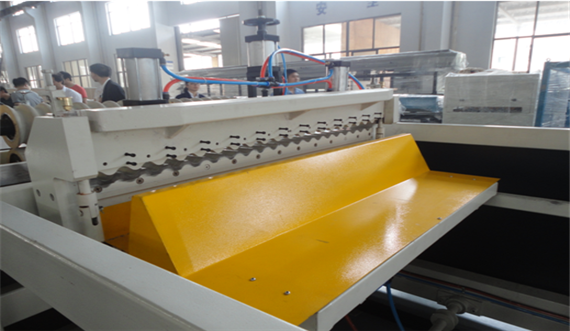
Extruder, die, forming and cutting details
Ask for photos, drawings and measured test data for the exact equipment you plan to buy.

Factory acceptance test checklist
Cut sections from the start, middle and end of the run. Measure skin and rib thickness, check for voids and compare the result with the approved profile drawing. Outer appearance alone is not enough.
- Approved hollow profile drawing
- Skin and rib thickness at agreed section points
- Rib fill and void inspection
- Width, height, pitch and flatness checks
- ASA cap coverage and adhesion
- Colour and surface appearance
- Output at the agreed profile and formula
- Cut length and edge integrity
- Fixing-zone dimensions for the roof system
- PV mounting review where applicable
Common questions from roof tile manufacturers
Answers for engineering, purchasing and project teams comparing a new PVC roof tile line.
What is the price of a PVC hollow roof tile production line?
Pricing depends on the profile size, number of cavities, die and calibration complexity, extruder size, ASA coextrusion, output and the PV mounting interface. Hollow profiles need more tooling work than simple corrugated sheets, so compare the die, calibrator and cooling scope as well as the extruder price.
What is a PVC hollow roof sheet machine?
A PVC hollow roof sheet machine is an extrusion line for twin-wall or multi-cavity roof panels. It includes an extruder, multi-cavity die, vacuum calibration, cooling, haul-off, cutter and stacker. Some suppliers call the complete line a hollow roof tile production line.
What makes a hollow roof tile different from a corrugated sheet?
A hollow tile has internal ribs or cavities that increase rigidity and change heat and sound behaviour. The extrusion die and calibration system are more complex, and quality depends on complete rib fill rather than only outer surface appearance.
Can you quote a hollow line without a profile drawing?
A preliminary discussion is possible, but a reliable quotation needs the finished profile drawing, wall-thickness targets, fixing details and intended application. The die and calibrator are profile-specific.
Is a hollow tile automatically suitable for solar panels?
No. PV integration depends on the mounting rail, clamp position, load path, wind uplift, thermal movement and project approval. The tile profile can be designed for PV compatibility, but the complete roof assembly must be evaluated.
Which markets benefit most from hollow profiles?
Hot climates, agricultural buildings, chemical and pharmaceutical facilities, warehouses and large-span roofs often value the combination of heat insulation, sound reduction and rigidity. The final choice should be based on local codes and installation practice.
How do you verify internal quality?
Use section samples from the start, middle and end of the run. Measure skin and rib thickness, inspect for voids, check ASA cap coverage and record the results against the approved drawing.
What is the typical delivery scope?
The scope normally includes the extruder package, die, calibration system, cooling, haul-off, cutter, stacker, control system and agreed auxiliary equipment. Confirm whether installation, commissioning, training, formula support and spare parts are included in the quotation.
Can a hollow roof tile line be customized for a PV mounting system?
The tile profile can be developed around a defined fixing zone, clamp position and rail spacing. However, the complete roof assembly still needs load, wind uplift, thermal movement and installation reviews. Provide the PV mounting drawing before the die design is frozen.
Explore other PVC roof tile lines
Choose the page that matches your finished product, then confirm the machine scope with the BENK team.
Send your tile profile for a line recommendation
Share a drawing, sample photo, target thickness, layer structure and expected output. We will return a configuration with the main machine scope, tooling requirements, utilities and acceptance criteria.