An RTP pipe can look perfect on the outside and still fail at the end fitting. That is why experienced buyers now ask a more useful question than “What is the price per meter?” What evidence do you have that the pipe system has been tested?
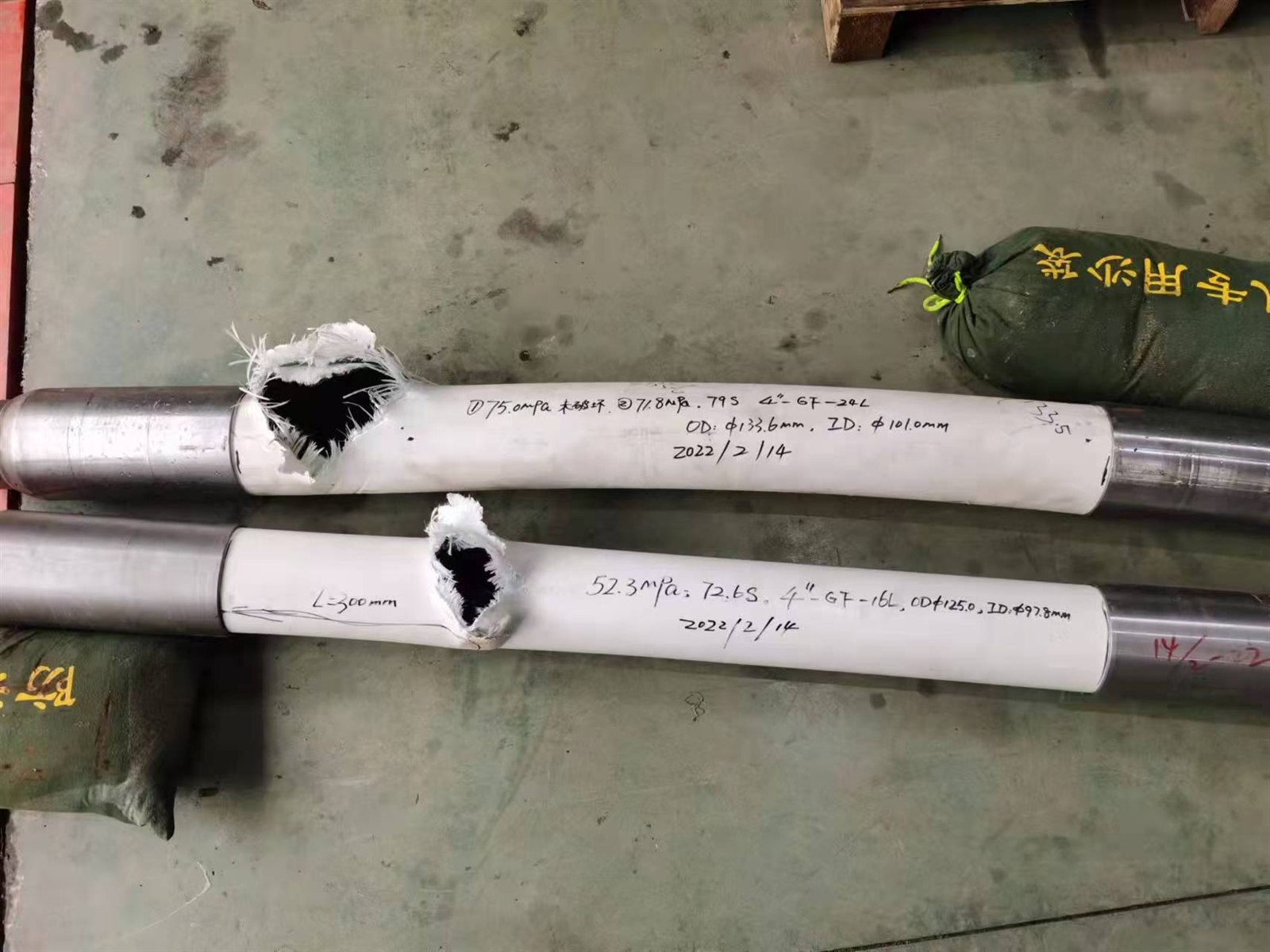
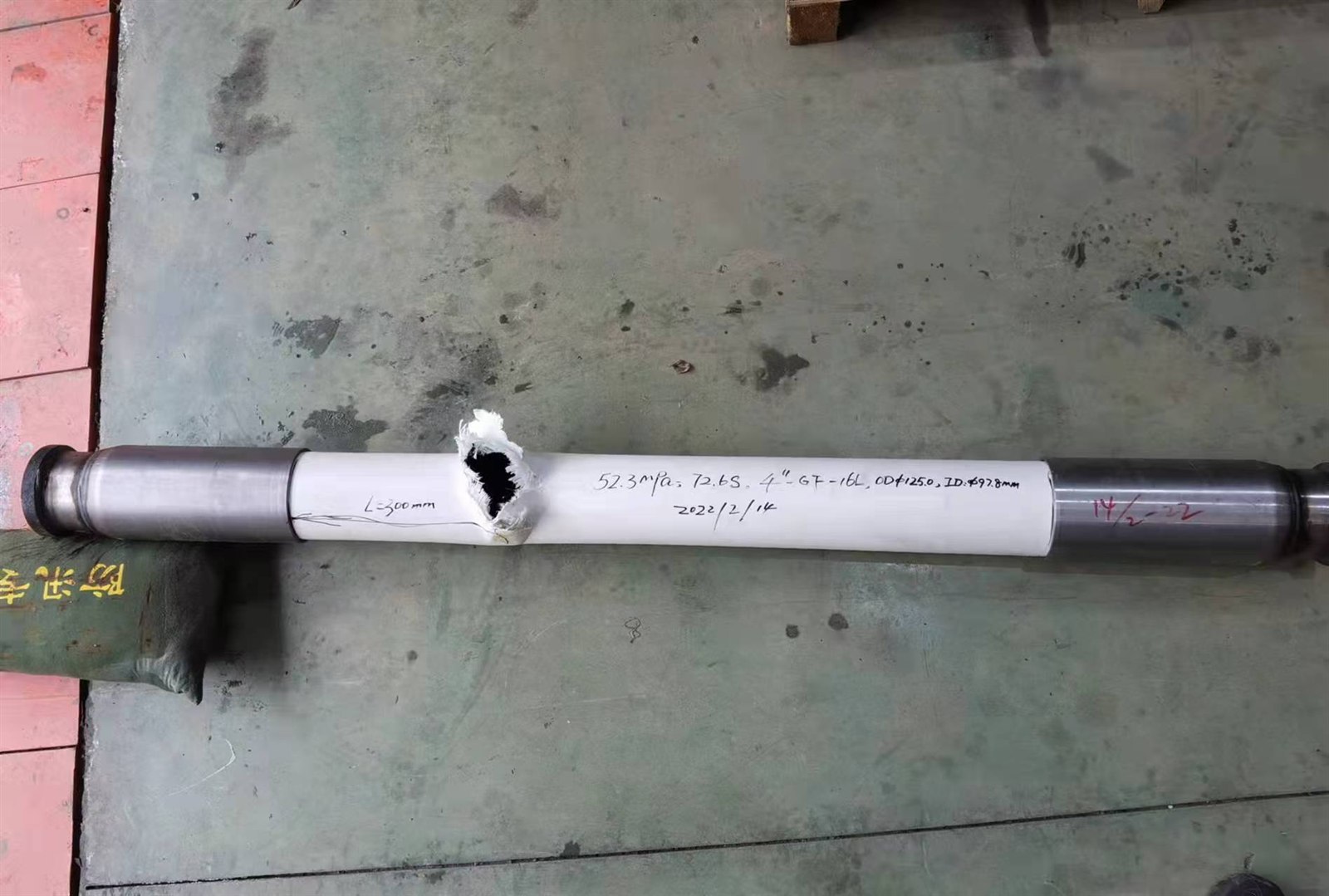
The photographs and records below come from a burst-test programme for a 4-inch, 16-layer glass-fibre reinforced thermoplastic pipe. The supplied report shows a burst pressure of 52.3 MPa and a time to burst of 72.6 seconds under the test standard listed on the sheet, API 15S. The result is striking, but its real value is what it reveals about the interaction between liner, reinforcement, jacket, process control and end connection.
This guide explains what RTP pipe testing can prove, what it cannot prove, and why the test bay is only the final checkpoint in a production system that begins with the RTP pipe production line.
What is RTP pipe testing?
RTP stands for reinforced thermoplastic pipe. A typical construction combines a thermoplastic liner, one or more load-bearing reinforcement layers, and an outer protective jacket. The pipe is spoolable, corrosion-resistant and lightweight compared with rigid steel or GRP systems. It is also a system: the pipe body, end fitting and installation method must work together.
RTP pipe testing therefore goes beyond checking whether a sample can hold pressure. A credible qualification programme examines:
- Short-term pressure capacity, including burst behaviour;
- Long-term hydrostatic performance under sustained pressure;
- Pressure cycling and fatigue resistance;
- Elevated-temperature performance at the material’s maximum allowable operating temperature;
- End-fitting integrity under pressure and axial load;
- Chemical compatibility, UV exposure and handling damage for the intended service;
- Dimensional consistency of the liner, reinforcement and jacket.
The exact test matrix depends on the product specification, the application and the edition of the standard. API Spec 15S addresses spoolable reinforced plastic line pipe. ASTM D1599 describes a short-time hydraulic pressure test method. DNV-ST-F119 covers thermoplastic composite pipes, while ISO/TS 18226 addresses reinforced thermoplastics pipe systems for gaseous fuel supply up to 4 MPa. These documents do different jobs; one test method alone should not be presented as a complete product qualification.
A real test record: 52.3 MPa on a 4-inch RTP sample
The supplied record is a useful example because it contains the details a buyer should normally request: specimen identification, dimensions, nominal class, test standard, burst pressure, time to burst and the pressure/time curve.
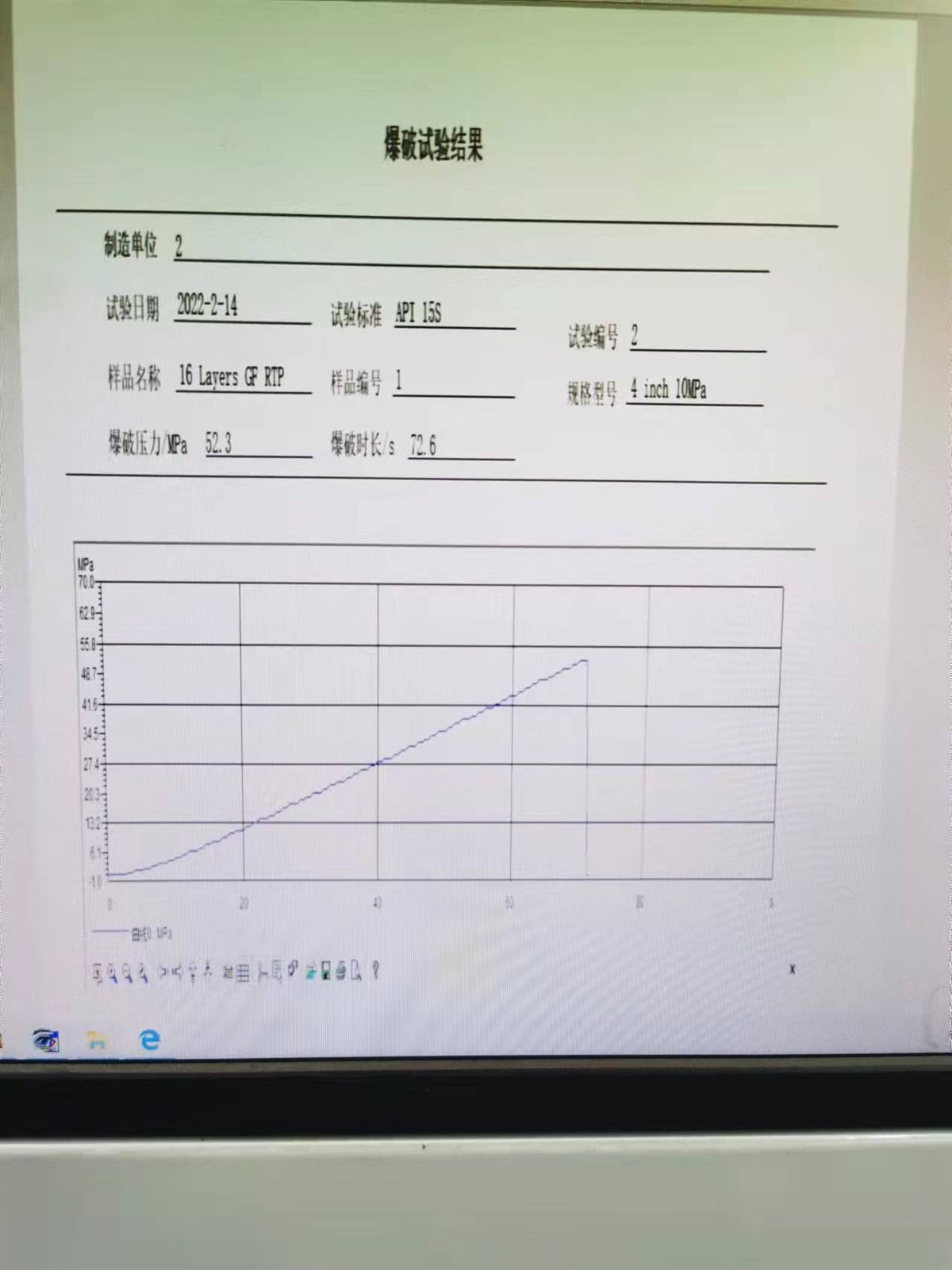
| Recorded item | Value |
|---|---|
| Specimen | 4-inch, 16-layer glass-fibre RTP |
| Nominal class shown | 10 MPa |
| Outside diameter | 125.0 mm |
| Inside diameter | 97.8 mm |
| Test standard | API 15S |
| Burst pressure | 52.3 MPa |
| Time to burst | 72.6 s |
| Test date | 14 February 2022 |
On the face of the sheet, 52.3 MPa is about 5.2 times the 10 MPa nominal class. That ratio is interesting, but it must be read correctly. A short-term burst result is not a working-pressure rating. It is one piece of evidence about short-term capacity under the specific test conditions. The design pressure still depends on the product family, safety factor, temperature, service fluid, cyclic loading and long-term regression data.
Inside the burst test: what happens before the pressure drop
A burst test is a controlled experiment, not simply “pump until it breaks.” A typical sequence includes:
- Condition and document the specimen. Record dimensions, layer construction, batch and fitting details.
- Fill and vent. Remove air from the specimen so that the pressure is transmitted by water rather than trapped gas.
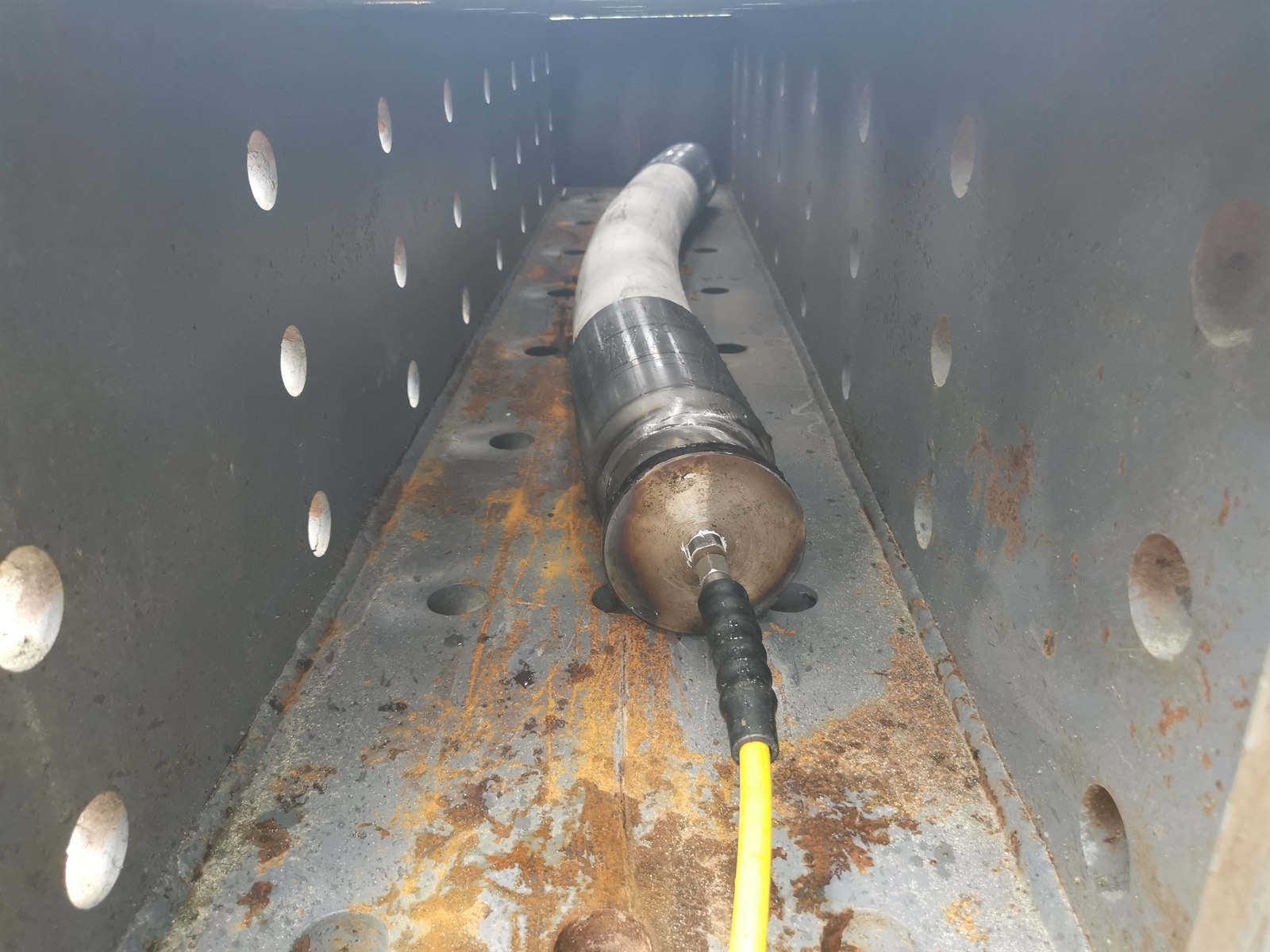
- Install the specimen safely. Use a protective enclosure, restraints and suitable end closures.
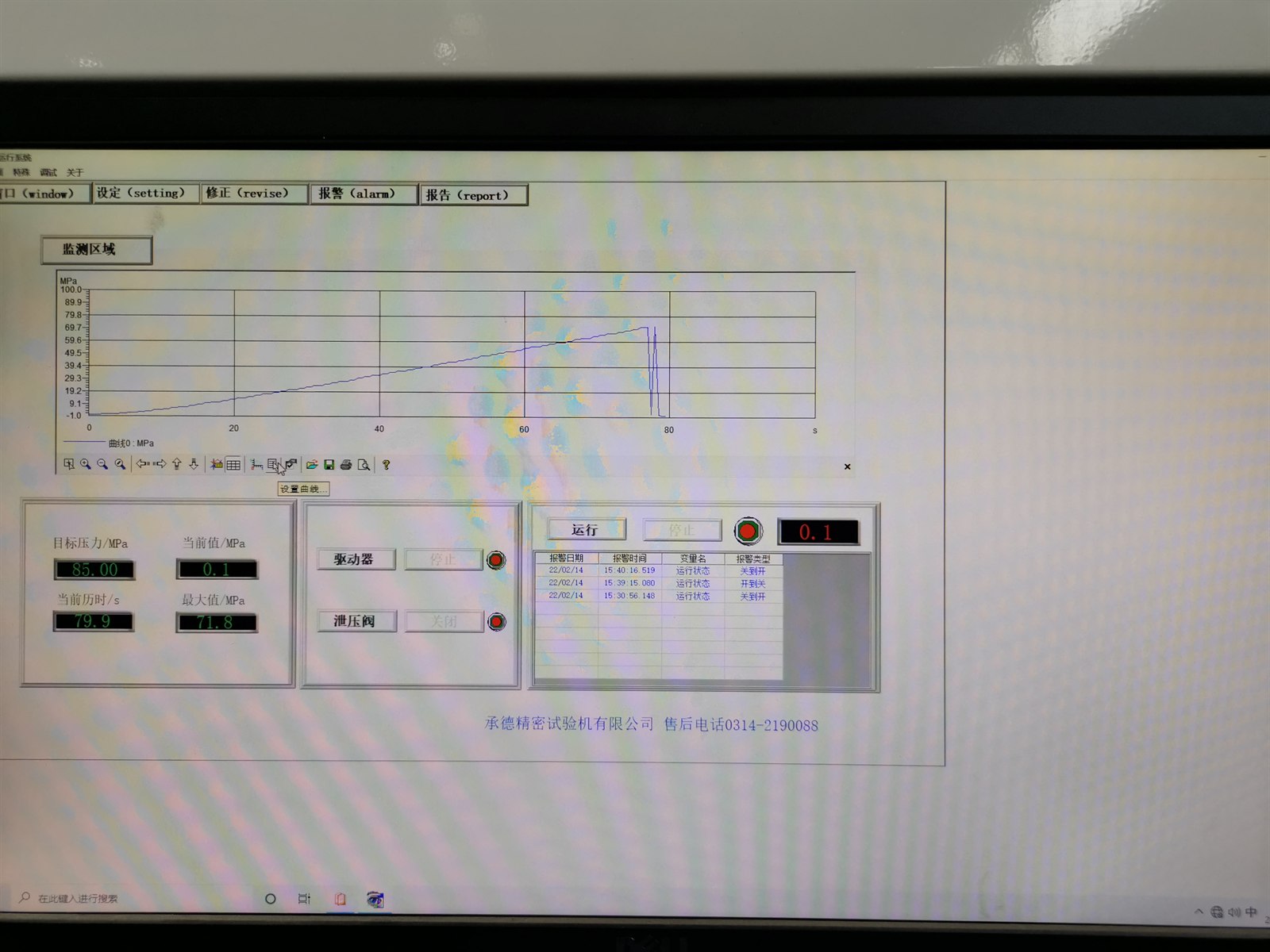
- Increase pressure at a controlled rate. Record pressure and time throughout the run.
- Identify the failure event. Note the burst pressure, time, location and failure mode.
- Inspect the failure. Photograph the rupture, end fitting and any secondary damage.
- Compare with the specification. Evaluate the result against the relevant product family, test standard and qualification plan.
Burst pressure is not the whole qualification story
Burst testing is valuable because it exposes the short-term limit of the complete pipe system. It is not sufficient on its own. A pipe that survives a high-pressure burst test can still perform poorly in sustained pressure, pressure cycling, elevated temperature or chemical exposure.
| Test area | Question it helps answer | Why it matters |
|---|---|---|
| Short-time burst | What is the short-term pressure limit of this specimen? | Design validation, product-family comparison and quality control. |
| Long-term hydrostatic | How does the pipe behave under sustained pressure? | Creep, ageing and pressure-rating confidence. |
| Pressure cycling | Can it tolerate repeated pressure changes? | Fatigue and service-cycle relevance. |
| Elevated temperature | How much capacity is retained at the maximum operating temperature? | Prevents room-temperature data being used outside its valid range. |
| End fitting / connection | Is the joint as reliable as the pipe body? | Field failures often initiate at terminations. |
| Environmental / chemical | Does the service environment degrade the materials? | Liner compatibility, UV protection and jacket durability. |
| Handling / installation | Can the pipe survive bending, impact and point loading? | Spooling, transport and field deployment can introduce damage. |
What the failure mode can reveal
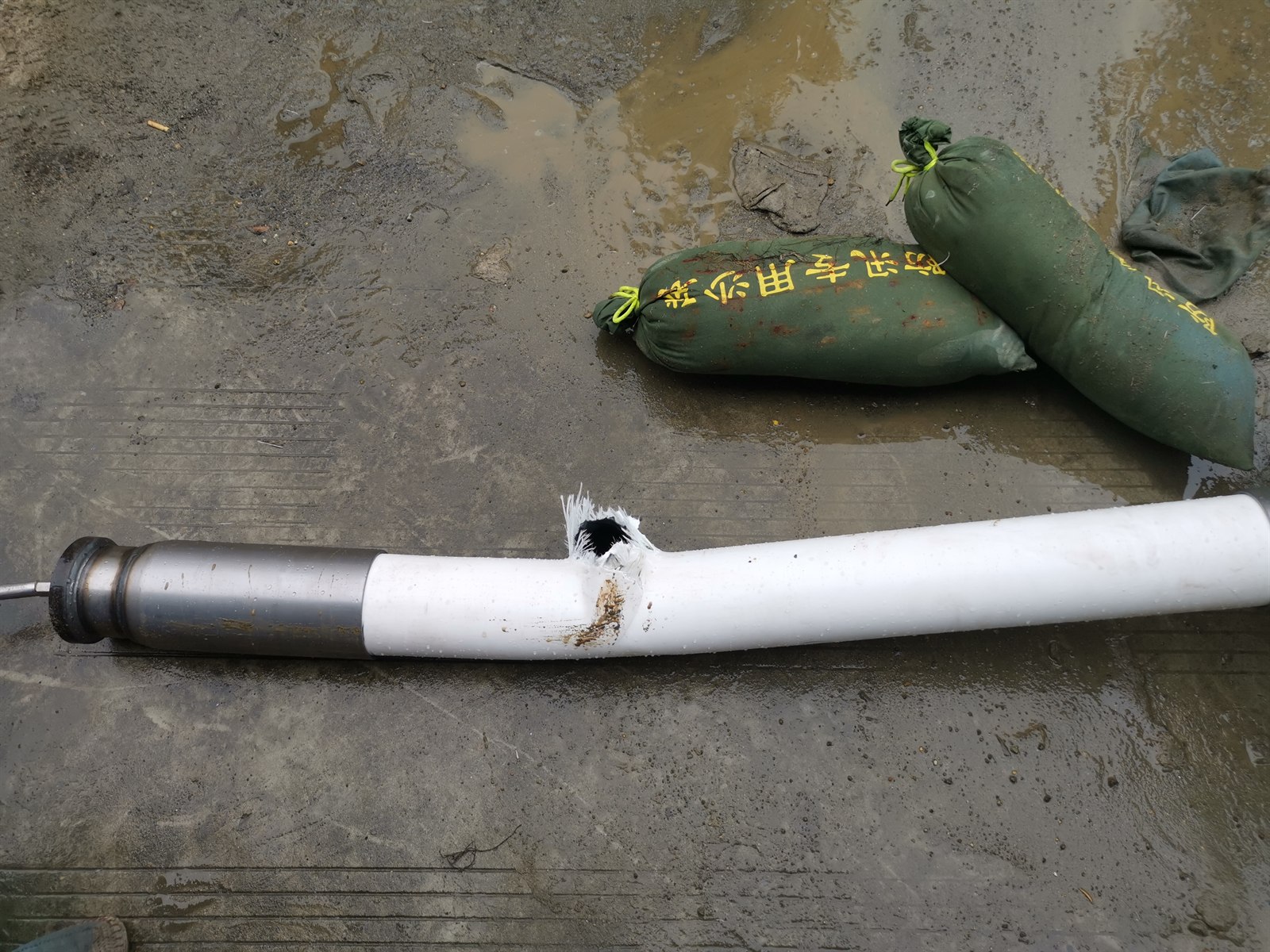
The photographs show a localized rupture through the jacket and reinforcement rather than a clean pull-out at the end fitting. That is a useful observation: the visible failure is in the pipe body, not at the termination. But a photograph alone is not a failure analysis. A complete record should identify the exact failure location, the condition of the liner, whether reinforcement layers slipped or fractured, and whether the end fitting remained sealed.
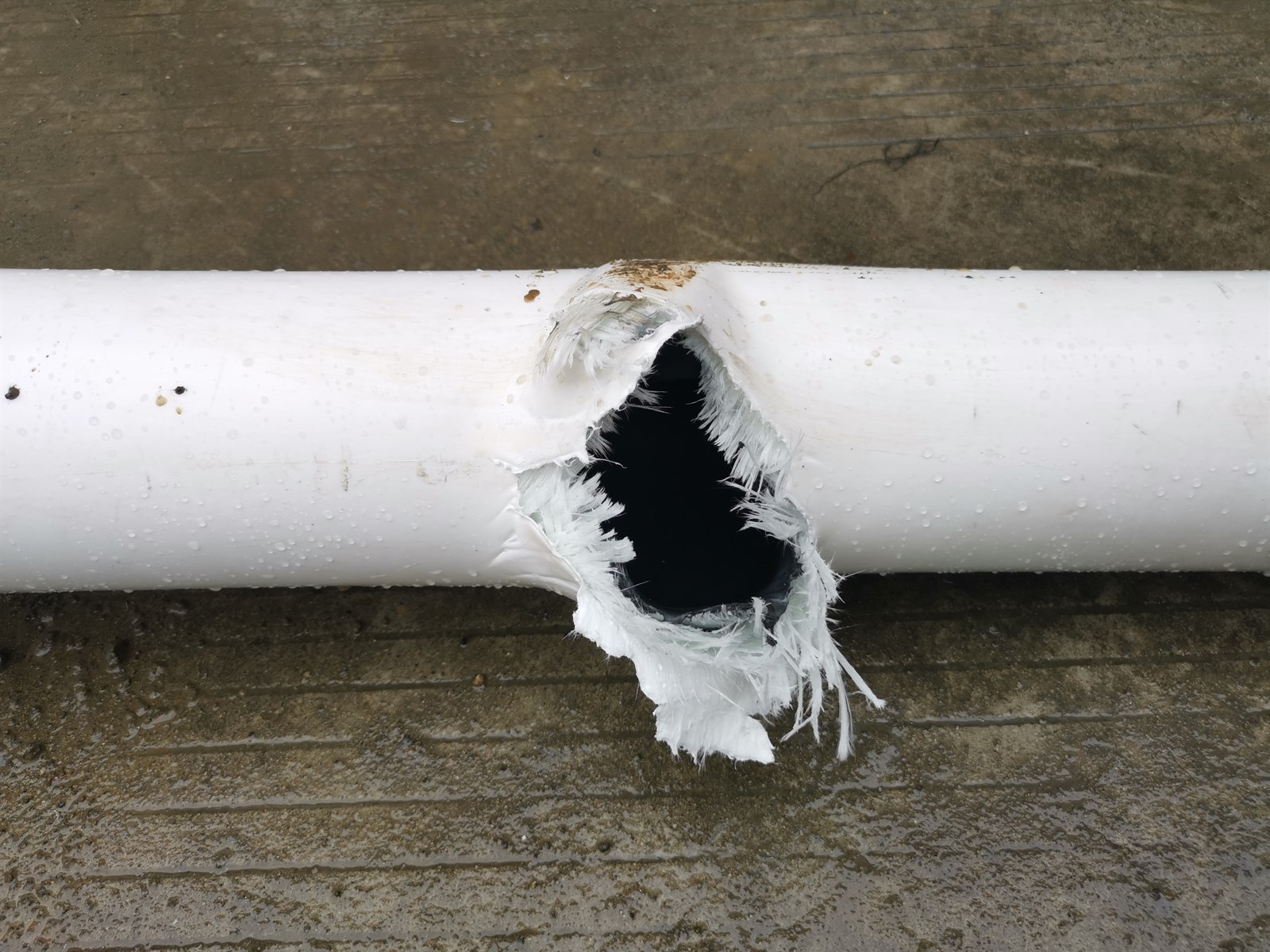
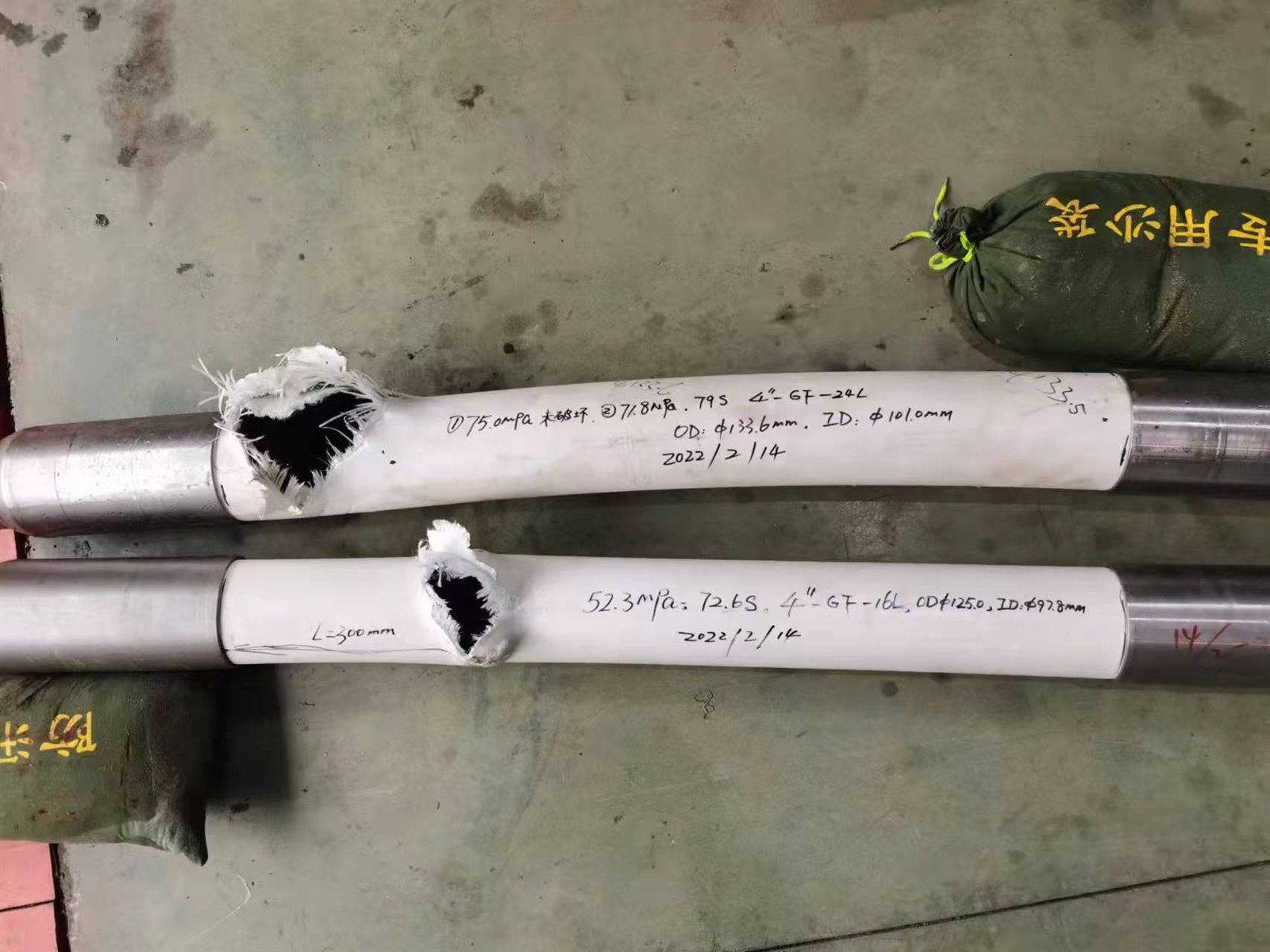
Different failure modes point to different questions. A pipe-body rupture may raise questions about reinforcement strength, winding pattern, liner support or local damage. A fitting pull-out points to termination design, installation torque or axial load transfer. A longitudinal split may indicate a liner or processing issue. The value of the test is not just the maximum pressure; it is the combination of pressure, time, location and mode.
Why RTP pipe testing starts on the production line
Burst pressure is the final number on the certificate, but it is created upstream. A stable RTP production process depends on several linked controls:
- Liner extrusion: wall thickness, ovality, melt quality and contamination control;
- Reinforcement winding: winding angle, tape tension, spacing and fibre damage;
- Heating and consolidation: temperature uniformity across the pipe and reinforcement;
- Jacket extrusion: thickness, adhesion and UV protection;
- Line control: repeatable speed, tension and dimensional feedback;
- End-fitting preparation: a controlled interface between the pipe body and the connection.
This is why a test result should be traceable to a production batch, material lot and line setting. A single impressive burst number without traceability is a marketing claim. A repeatable test record tied to material, dimensions, process parameters and failure analysis is engineering evidence.
From test record to production line
BENK’s RTP pipe production line integrates liner extrusion, reinforcement winding, heating, jacket extrusion, cooling, haul-off, cutting and coiling. The objective is not only to reach a pressure number, but to make the same qualified structure repeatably.
More views from the same test set
Test photographs are most useful when they show the whole story: the specimen before failure, the protective setup, the recorded curve and the condition after the pressure event. These additional views document the same burst-test programme.
The RTP pipe market is asking harder questions
As operators look for corrosion-resistant, spoolable and lower-installation-cost alternatives, the RTP pipe market is becoming more technical. Buyers compare reinforced thermoplastic pipe, flexible composite pipe and conventional rigid pipe on total installed cost, not just price per metre. They ask for pressure ratings, bend radius, connection details, chemical compatibility and test documentation.
That is healthy. The cheapest quotation can be expensive if it lacks a qualified product family, traceable materials, validated end fittings or a repeatable production process. For a project with cyclic pressure, elevated temperature or aggressive fluids, a single burst test is not enough. The right question is: what is the complete evidence package behind this RTP pipe system?
Buyer checklist: 8 questions before approving an RTP supplier
- What is the exact RTP construction: liner material, reinforcement type, layer count and jacket?
- What are the design pressure, nominal class, temperature range and safety factor?
- Can the supplier provide burst-test records with raw pressure/time curves and specimen identification?
- Has the product family been evaluated for long-term hydrostatic, cyclic and elevated-temperature performance?
- How was the end fitting or connection qualified?
- Does the report identify failure location and failure mode, not only the peak pressure?
- Can the pipe be traced to material lots, production batches and line settings?
- Is the production line capable of repeating the qualified dimensions, winding angle and jacket quality?
FAQ: RTP pipe testing and reinforced thermoplastic pipe
What is an RTP pipe?
An RTP pipe is a reinforced thermoplastic pipe with a thermoplastic liner, a reinforcement layer and usually an outer jacket. It is spoolable and is used in applications where corrosion resistance, low weight and fast installation matter.
Is flexible composite pipe the same as RTP?
“Flexible composite pipe” is a broad description. RTP is a specific family of spoolable reinforced thermoplastic pipe. Buyers should confirm the construction, pressure rating, reinforcement material and applicable standard rather than relying on the generic name.
What does a 52.3 MPa burst result mean?
It means that the particular specimen reached 52.3 MPa before failure under the conditions of that test. It does not mean the pipe has a 52.3 MPa working pressure. Design pressure must come from the qualified product family, safety factor and service conditions.
Is RTP pipe testing the same as RT inspection?
No. In search results, “RTP pipe” is sometimes confused with “RT” (radiographic testing). RT is a non-destructive examination method. RTP pipe testing here refers to pressure, mechanical and system-qualification tests on reinforced thermoplastic pipe.
How much does RTP pipe cost per metre?
There is no meaningful single price. Cost depends on diameter, pressure class, liner and reinforcement materials, layer count, jacket, end fittings, test documentation, order quantity and delivery. Compare total installed cost, not only the pipe price.
How do I choose an RTP pipe production line?
Start with the target product: inside diameter, pressure class, reinforcement type, layer structure, winding angle, line speed and quality-control requirements. Then verify the line’s dimensional control, winding tension, heating uniformity, jacket quality and traceability. A line is only suitable if it can repeat the qualified construction.
Conclusion: a test number is only as useful as the system behind it
The 52.3 MPa result is a useful reminder that RTP pipe can carry substantial short-term pressure. But the real lesson is broader. A trustworthy RTP pipe supplier should be able to connect the test number to a defined construction, a controlled production line and a complete qualification file.
If you are developing a new RTP product or evaluating a production line, send BENK your target dimensions, pressure class, reinforcement material and test standard. Our team can help match the line configuration to the product and the evidence package you need.
Discuss your RTP pipe project with BENK
RTP pipe production lines | liner extrusion | reinforcement winding | jacket extrusion | testing and quality control
Standards and further reading
- API Spec 15S, Spoolable Reinforced Plastic Line Pipe (2022 edition).
- ASTM D1599-18(2024), Standard Test Method for Resistance to Short-Time Hydraulic Pressure of Plastic Pipe, Tubing, and Fittings.
- DNV-ST-F119, Thermoplastic composite pipes.
- ISO/TS 18226:2006, Plastics pipes and fittings – Reinforced thermoplastics pipe systems for the supply of gaseous fuels for pressures up to 4 MPa (40 bar).
Photo note: the images in this article are from BENK’s supplied RTP burst-test photo set. Test values are specimen-specific. Always validate a product against the applicable specification, project requirements and a complete qualification programme.