
WDP-06 · Surface and finish
WPC Door Panel Surface Finishing Line: A Better Face Starts at the Die
A decorative film cannot hide a wave in the substrate. The face of a WPC door panel is created by the die, calibration, cooling and handling long before any film or texture is applied.
Technical review: BENK Machinery · Updated 6 November 2026
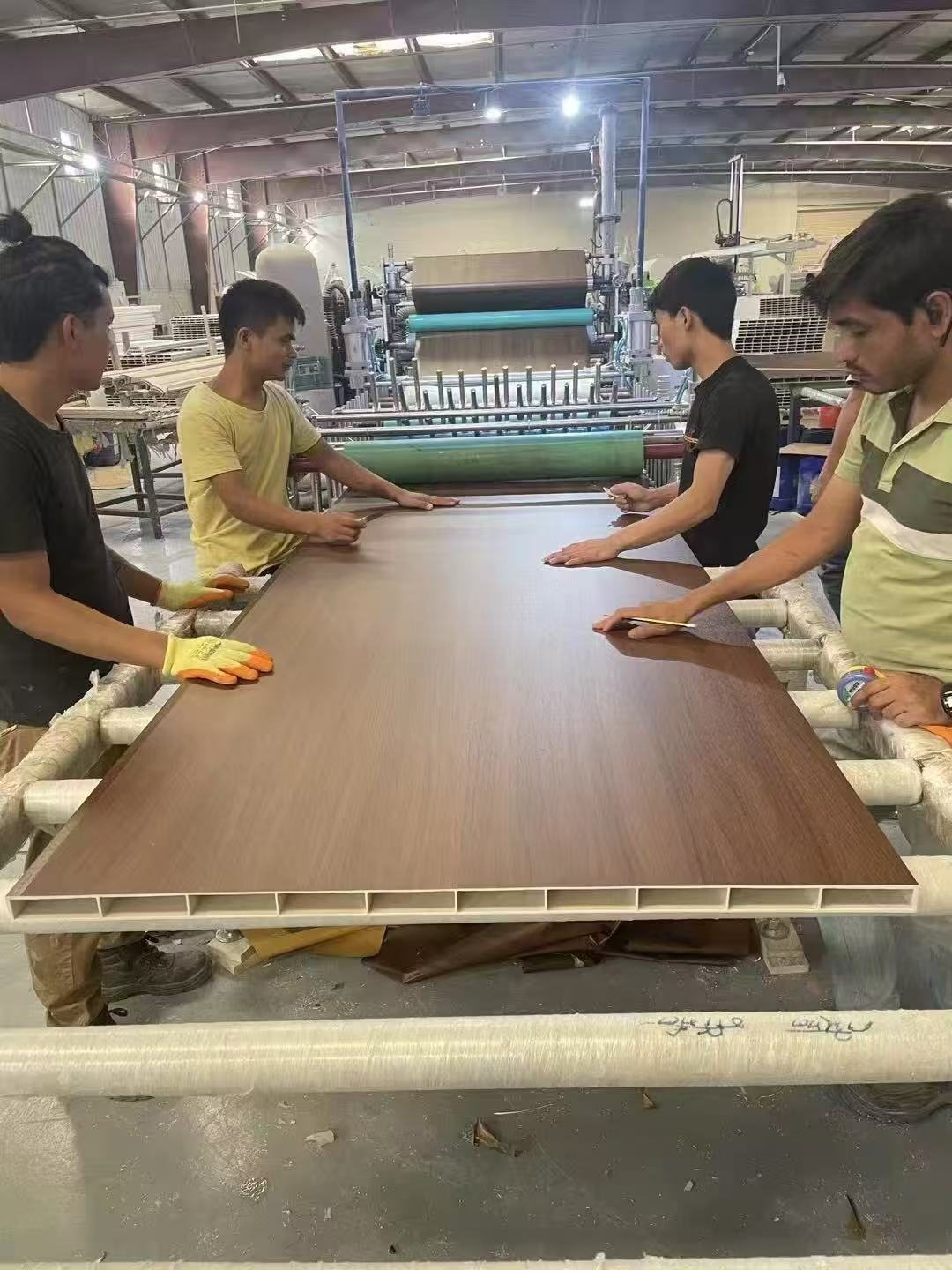
Buyers often judge a WPC door panel from a sample. The sample may be flat, warm to the touch and consistent in colour. At production speed, the same face can develop streaks, dull patches or a slight orange-peel effect if the melt and cooling are not controlled.
This page looks at surface finishing as a line problem rather than a final cosmetic step. It is relevant to factories making smooth panels, wood-grain panels or panels that will receive a decorative film.

Where surface defects begin
The die and calibrator touch the melt while it is still soft. A polished flow surface helps, but it cannot compensate for unstable pressure, cold spots or uneven vacuum. Small changes can appear as gloss bands, drag marks or a face that varies from one edge to the other.
Handling also matters. If the panel is supported poorly after calibration, the hot edge can deform. If the cutter clamps too hard, the mark may only show after lamination because the film follows the surface beneath it.
- Dull bands or gloss variation
- Wood-grain depth that changes across the width
- Orange-peel appearance under film
- Edge chipping or white marks
- Surface scratches from rollers or stacking
Choosing the right surface route
A smooth panel, a textured panel and a film-laminated panel are not the same product. The die, calibrator and downstream equipment should be chosen for the intended finish. A texture that is pressed too shallow may disappear after sanding, while a film may show every small wave in the substrate.
For film lamination, the panel should be flat and clean before adhesive or thermal bonding. For painted or printed finishes, surface consistency and edge quality become even more visible. The finish route should be agreed before the line layout is fixed.
How BENK plans surface quality into the line
BENK's door-board die and calibration tooling are designed with polished flow surfaces and controlled contact through the vacuum table. The haul-off and stacking sections can be arranged to protect the decorative face, while the cutter support is selected for the panel length and edge quality required.
Where a buyer needs film lamination or embossed texture, those steps can be reviewed as part of the production route. The important point is to test the finished sample, not just a bare board. Surface quality should be checked before and after the selected finishing process.
- Die flow surfaces polished for the target finish
- Calibration and support arranged to reduce roller marks
- Haul-off pads selected for the visible face
- Cutting and stacking methods that protect edges
- Finish trials using the actual film, texture or coating
Production sequence
From material preparation to finished panel
- 01
Define the visible face
Decide whether the panel will be smooth, textured, printed or film-laminated.
- 02
Set the melt condition
Stabilise temperature and pressure before adjusting surface settings.
- 03
Polish and protect the die
Keep flow surfaces clean and free from damage.
- 04
Calibrate with even contact
Support the face without creating drag or vacuum marks.
- 05
Handle after cooling
Use rollers and stacking that do not mark the panel.
- 06
Apply the finish
Laminate, emboss, sand or coat according to the approved route.
- 07
Inspect under the right light
Check colour, gloss and texture at the viewing angle used by the customer.
Reference window
Reference specification and planning range
The figures below are a starting point for discussion. The final line specification should follow the approved panel drawing, material formula and trial result.
| Tétel | Reference / planning note |
|---|---|
| Face options | Smooth, wood-grain, embossed or film-laminated depending on tooling and process |
| Die contact | Polished flow surfaces for the intended appearance |
| Kalibrálás | Vacuum and cooling support matched to the face quality |
| Leválasztás | Surface-protective pads and controlled clamping |
| Finishing | Film lamination, embossing, sanding or coating reviewed as a separate process |
| Ellenőrzés | Gloss, colour, texture, flatness and edge condition |
How BENK fits the project
Where the BENK line supports the result
BENK can configure the extrusion and downstream section around the intended surface route. Film lamination, embossing or coating may require separate equipment and a joint trial with the material supplier, so the finish should be defined before the line is ordered.
Buyer checklist
What to settle before you compare quotations
- Ask for a finished sample in the exact colour and texture, not a generic board.
- Check the face under both direct and angled light.
- Confirm whether the film or coating supplier has approved the substrate.
- Review roller contact and stacking before the line is accepted.
- Agree on a defect limit for gloss variation, scratches and edge marks.
Questions buyers ask
WPC door panel line FAQ
Can a WPC door panel be film-laminated?
Yes, but the substrate needs to be flat, clean and suitable for the selected film and bonding method. A trial with the actual film is the best way to confirm the result.
Does the die affect the surface finish?
It does. The die flow surface, temperature balance and pressure distribution all influence gloss, texture and visible flow marks.
How do you check surface quality?
Use a defined light source and viewing angle, then compare the sample with an approved master. Check both the panel face and the cut edges.
Can BENK supply the lamination line too?
The finishing route can be reviewed with the main line. The exact scope depends on whether the process is inline, offline or handled by a specialist partner.
Project brief
Tell us the panel, not just the machine.
Send the panel drawing, material formula, target output and factory location. BENK can then review the line configuration against the actual product.