PVC Synthetic Resin & Glazed Roof Tile Production Line
This line makes ASA/PVC synthetic resin roof tiles in Spanish, Roman, antique glazed and other embossed profiles. Typical widths are 880 mm and 1050 mm, with two to four layers and ASA or PMMA surface options. The die, embossing roll, calibrator and cutter are selected from the tile drawing.
- Profile drawing review
- آزمون پذیرش کارخانه
- Commissioning and operator training
- Updated 2026-11-19

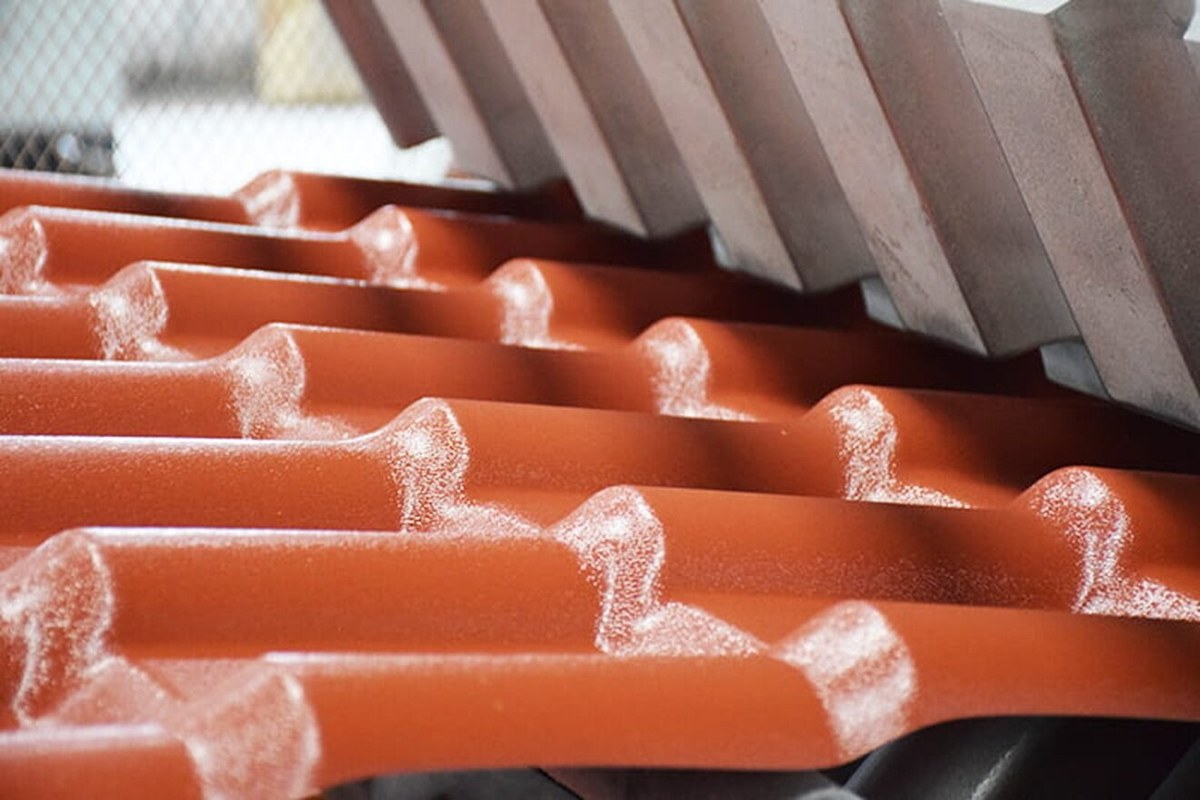
Representative product-family photo; final BENK line configuration may differ.
How the line matches your roof tile specification
A synthetic resin roof tile combines a PVC substrate with a thin ASA or PMMA cap. The cap controls colour and UV resistance; the PVC layer provides strength, stiffness and the roof tile shape. Most production problems begin with uneven layer distribution, incorrect melt temperature, shallow embossing or poor cooling, so these parts need to be reviewed together.
The usual configuration uses a conical twin-screw extruder for PVC and a smaller single-screw extruder for ASA or PMMA. Both melts pass through a distributor and coat-hanger die, then through the embossing roll and profile calibrator. The haul-off and cutter are sized to the line speed and finished tile length.
ASA film lamination can replace the cap extruder when a reliable film supply is available. A third or fourth layer may include reclaimed PVC or a functional core. Test the formulation and appearance standard before fixing the screw, die and layer configuration.
The same equipment may be listed as a plastic roof tile making machine, composite roof tile production line, PVC roof tile manufacturing machine or turnkey PVC roof tile plant. Compare the included extruders, die, tooling, controls and commissioning rather than the product name alone.
برنامه های معمولی
- New roof tile factories building a defined export range
- Manufacturers adding Spanish, Roman or antique glazed profiles
- Buyers replacing a line with unstable thickness or colour
- Projects that need recycled PVC in a controlled middle layer
Roof profiles and tile formats
- Synthetic resin tile
- Antique glazed tile
- Spanish tile
- Roman tile
- Bamboo-joint tile
- Large-wave tile
- Custom embossed profile
From PVC compound to packed roof tile
The line combines material preparation, extrusion, forming, cooling, cutting and inspection. The settings at each stage affect thickness, surface finish and scrap rate.
Material dosing & mixing
PVC compound, stabilizer, filler, impact modifier and process aid are prepared to the approved recipe.
PVC plasticizing
A conical twin-screw extruder delivers a homogeneous melt at a controlled temperature profile.
ASA / PMMA cap
A separate single-screw extruder feeds the UV-resistant surface layer through the distributor.
Die & layer distribution
A coat-hanger die and layer distributor set width, thickness and cap coverage.
Embossing & forming
The embossing roll transfers surface texture before the profile is shaped in the calibrating section.
Cooling & sizing
Staged cooling controls flatness, internal stress, rib fill and dimensional stability.
Haul-off & cutting
A profile-matched haul-off feeds a synchronous cutter for clean, repeatable lengths.
Stacking & inspection
Finished tiles are stacked, sampled and checked against the approved dimensional and appearance standard.
How layer structure affects cost and weather resistance
The number of layers changes the extruder count, material cost, UV protection and the options for using reclaimed PVC.
PVC mono-layer
Lowest tooling complexity. Suitable where UV protection comes from a coating system or where the tile is not directly exposed.
PVC / ASA or PVC / PMMA
The most common export configuration: a thin UV-resistant cap over a rigid PVC substrate, with colour and gloss controlled at the die and embossing stage.
Three-layer structure
Adds a controlled reclaimed or functional middle layer while keeping the UV cap and a bright underside. Regrind ratio must be validated with the formulation.
Four-layer or film-laminated
Separates colour, UV, functional core and base. ASA film lamination is an alternative when the buyer prefers a preformed surface system.
Typical PVC roof tile line specifications
Use these figures for preliminary planning. The quotation drawing and approved datasheet should replace every range with a confirmed value.
| پارامتر | Typical project scope |
|---|---|
| Finished profiles | Synthetic resin, antique glazed, Spanish, Roman, bamboo, large-wave and custom profiles |
| Usable width | 880 mm and 1050 mm typical; other widths subject to profile and tooling review |
| Finished thickness | 1.5–3.0 mm typical; approved by profile, layer structure and test standard |
| Surface system | ASA or PMMA coextrusion; ASA film lamination option |
| Layer options | PVC mono-layer, PVC/ASA, three-layer and four-layer constructions |
| سازنده اصلی | Conical twin-screw PVC extruder, sized to output and compound |
| Cap extruder | Independent single-screw ASA/PMMA extruder where coextrusion is selected |
| Die package | Coat-hanger die, layer distributor, profile-specific calibrator and embossing roll |
| Downstream | Forming machine, cooling section, haul-off, synchronous cutter and stacker |
| کنترل کنترل | PLC and variable-frequency drives; recipe and alarm functions according to scope |
| Output reference | Approximately 300–450 kg/h, depending on width, thickness, formulation and line configuration |
| Auxiliary scope | Ridge tile, hip, end-cap and T-junction tooling; mixer, loader, crusher and pulverizer options |
How to read this table: “Typical” means a common market configuration, not a guaranteed performance figure for every project. Output and thickness depend on the finished profile, formulation, layer ratio and cooling capacity.
What to check before you place an order
Compare the full production system, including the die, calibration, cooling, cutting and tooling package. A lower extruder price can lead to higher scrap or slower changeovers.
Die and layer balance
Check layer distribution, edge trim allowance and colour uniformity across the full width. Ask how the distributor is cleaned and checked after a profile change.
Thickness tolerance
Ask for measurement data across the sheet and along the run. Thickness control affects tile weight, stiffness, resin use and the final selling price.
Embossing consistency
Compare texture depth, gloss and release after several hours of running. A shallow or uneven pattern is difficult to sell as a premium glazed tile.
Cooling and flatness
Short cooling sections can limit output on thicker tiles. Check flatness after cutting and stacking, not only at the die.
ASA or PMMA cap control
The UV cap needs enough thickness for the warranty target without adding unnecessary material cost. Ask how cap ratio is measured and recorded.
Profile changeover
Multiple Spanish, Roman or antique profiles can run on one line when the die, calibrator, embossing roll and setting sheets are organised. Confirm realistic changeover time with a trained crew.
Line size and output
A larger extruder or wider die raises the machine price, but only helps when cooling and downstream equipment can support the output. Require kg/h at the exact width, thickness and layer structure.
Tooling package
Ridge, hip, end cap, T-junction and spare die costs can be a significant part of the project. Compare a separate tooling list, not only the main line price.
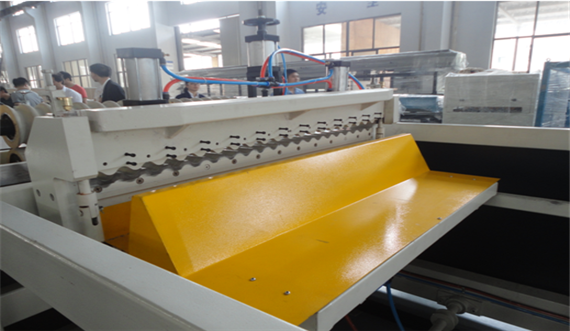
Extruder, die, forming and cutting details
Ask for photos, drawings and measured test data for the exact equipment you plan to buy.

Factory acceptance test checklist
Run the factory acceptance test with the tile profile, PVC formula and ASA/PMMA grade that will be used in production. The test should show stable thickness, colour, embossing and cutting over a sustained run.
- Approved profile drawing and colour target
- Measured width, thickness and wave geometry across the run
- ASA/PMMA cap coverage and adhesion check
- Surface gloss, embossing and appearance sample
- Output test at an agreed formulation
- Cut length, squareness and edge quality
- Flatness and post-cutting dimensional check
- Utility, safety and maintenance review
- Operator training and spare-parts list
- Packing and container-loading plan
Common questions from roof tile manufacturers
Answers for engineering, purchasing and project teams comparing a new PVC roof tile line.
What is the price of a PVC synthetic resin roof tile production line?
The price depends mainly on tile width, number of extruders and layers, die and calibrator tooling, embossing pattern, control system, output and the ridge/hip accessory package. A two-layer 880 mm line costs less than a four-layer 1050 mm line with several profiles. Ask for a quotation that separates the main line, tooling, freight and commissioning.
What is the difference between a plastic roof tile making machine and a complete production line?
A roof tile making machine may refer only to the extruder or forming unit. A complete PVC roof tile production line includes material handling, extruder or extruders, die, distributor, embossing, calibration, cooling, haul-off, cutter and stacker. Confirm which items are included before comparing prices.
What is the difference between a synthetic resin roof tile and a glazed roof tile?
They belong to the same extrusion family but differ in profile, surface depth and downstream tooling. Synthetic resin tile emphasizes the ASA/PVC composite construction; glazed tile emphasizes the deeper traditional profile and surface appearance. Confirm the exact profile drawing before selecting a die and calibrator.
Can one line produce Spanish, Roman and antique profiles?
Often yes, but not by changing only the cutter. The die, calibrator, embossing roll, cooling supports and downstream settings must match each profile. Ask for a documented changeover matrix and realistic changeover time.
Should I choose two, three or four layers?
Two layers are the simplest way to combine a UV cap with a PVC substrate. Three layers allow a controlled reclaimed or functional core. Four layers add flexibility for colour and functional separation but increase line complexity and validation work. The right choice depends on your product warranty, formulation and cost target.
Can recycled PVC be used?
Recycled PVC is normally considered for a middle layer, not the UV-exposed surface. The allowable ratio depends on source consistency, contamination, stabilizer package and the appearance standard. Require a trial with your own material before fixing the line configuration.
What information is needed for an accurate quotation?
Provide a profile drawing or target photo, usable width, thickness, layer structure, expected output, raw-material recipe, colour standard, cutting length, electrical standard and destination. A sample tile or existing die drawing shortens the review.
How is output confirmed?
Output should be confirmed in kg/h at a named formulation, width, thickness and layer ratio. Also record the stable running speed, scrap rate and downstream cooling limit. A single peak figure without those conditions is not a reliable comparison.
Can the line make 880 mm and 1050 mm roof tiles?
Both widths are common in this product family, but the die, calibrator and downstream tooling must be supplied for each width. If you plan to sell both sizes, request a changeover matrix and a list of shared and dedicated parts.
What output can I expect from a PVC roof tile extrusion line?
For this product family, a practical project range is often around 300–450 kg/h. Actual output depends on tile width, thickness, layer ratio, filler content, cooling capacity and the condition of the regrind. The quoted figure should be tied to a named product and formulation.
Explore other PVC roof tile lines
Choose the page that matches your finished product, then confirm the machine scope with the BENK team.
Send your tile profile for a line recommendation
Share a drawing, sample photo, target thickness, layer structure and expected output. We will return a configuration with the main machine scope, tooling requirements, utilities and acceptance criteria.