WDP-11 · Capacity planning
High Output WPC Door Panel Production Line: Where the Extra Capacity Actually Comes From
A higher kilogram-per-hour figure is useful only if the board still cools, cuts and stacks at the same quality. In door panels, the bottleneck often moves downstream as soon as the extruder gets faster.
Technical review: BENK Machinery · Updated 6 November 2026

Capacity discussions often start with the extruder model. For a WPC door panel line, that is only the first number. The die, calibration table and haul-off must be able to absorb the output without creating thickness variation or cooling stress.
This page is for factories planning continuous production, multiple shifts or a product mix that has outgrown a smaller line. It focuses on the practical changes that make a higher output figure usable.
Find the real bottleneck
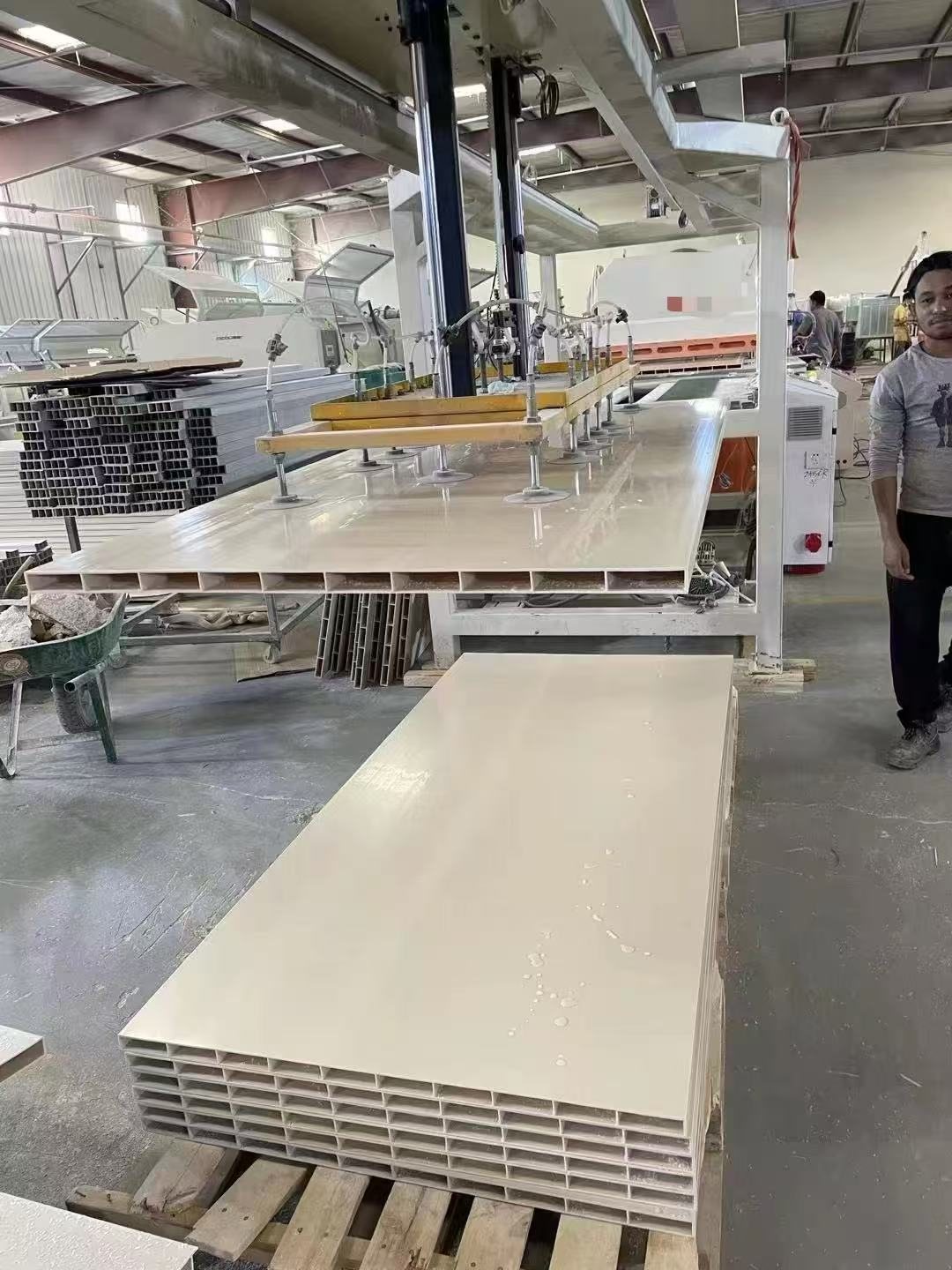
The extruder may be capable of more output while the vacuum table is already at its cooling limit. A faster haul-off can also create marks or distortion if the panel has not stabilised. Cutting and stacking may become the constraint when long panels need careful handling.
The useful approach is to map the cycle time of each step and test the line at the target speed for a full shift. A short peak run is not enough evidence for a factory planning three shifts.
- Melt capacity versus cooling capacity
- Haul-off force and surface marking
- Cutting accuracy at line speed
- Stacking and packing labour
- Scrap rate during start-up and changeover
What changes on a larger BENK line
The wider BENK reference models use the SJZ92/188 extruder and are quoted at roughly 600-800 kg/h, while the YF600 reference uses SJZ80/156 at around 350-400 kg/h. The haul-off range remains 0.5-6 m/min across the reference series, with force increasing for wider panels.
The line layout also changes. A wider panel needs more support, a suitable cutter opening and a stacking area that can handle the panel length without twisting. The factory aisle and packing flow should be checked before the equipment is ordered.
How BENK tests a high-output configuration
BENK can include a sustained trial around the buyer's panel size and formula. The test should record output, thickness, width, flatness, surface quality and scrap at the start, middle and end of the run. If the buyer plans more than one product, the changeover should also be timed.
Capacity should be quoted as a practical range, not a laboratory maximum. The final number depends on the formula, cooling water, factory temperature, operator routine and the quality standard for the panel.
- Continuous trial at the intended line speed
- Output and scrap recorded together
- Dimensions checked across the panel width
- Cooling water and room conditions recorded
- Packing rate included in the capacity review
Production sequence
From material preparation to finished panel
- 01
Set the production target
Define panels per shift, not only kilograms per hour.
- 02
Check the cooling load
Match the vacuum table and water system to the panel thickness.
- 03
Size the haul-off and cutter
Confirm force, opening and support for the widest panel.
- 04
Plan the packing flow
Make sure stacking and packing can keep up with the line.
- 05
Run a sustained trial
Test at the intended speed for a representative production period.
- 06
Record the quality window
Keep output and quality data from the same run.
- 07
Train for changeover
Include start-up and size-change time in the capacity plan.
Reference window
Reference specification and planning range
The figures below are a starting point for discussion. The final line specification should follow the approved panel drawing, material formula and trial result.
| Mục | Reference / planning note |
|---|---|
| Reference output | Approx. 350-400 kg/h for YF600; approx. 600-800 kg/h for YF800-YF1000 |
| Máy đùn | SJZ80/156 or SJZ92/188 according to model |
| Haul-off speed | 0.5-6 m/min in the reference series |
| Kích cỡ bảng điều khiển | 600 / 800 / 900 / 1000 mm reference models |
| Độ dày bảng | Commonly 40-50 mm for door boards |
| Capacity basis | Practical output after cooling, cutting, stacking and quality checks |
How BENK fits the project
Where the BENK line supports the result
BENK can configure a high-output WPC door panel line around the panel size, formula and shift target. The final capacity should be confirmed with a sustained trial and the buyer's quality standard, not taken from a maximum machine rating alone.
Buyer checklist
What to settle before you compare quotations
- Ask for output and scrap rate in the same trial report.
- Check whether the cooling system can handle the hottest month in your factory.
- Confirm the cutter and stacking table can handle your longest panel.
- Include packing labour in the shift plan.
- Test a complete shift, not just a few boards.
Questions buyers ask
WPC door panel line FAQ
What is the maximum output of a BENK WPC door panel line?
The reference range is approximately 350-800 kg/h depending on model, panel width and section. The practical figure for a specific product is confirmed during the trial.
Why does a wider line not always produce more saleable panels?
Cooling, cutting, stacking and scrap can limit the usable output. The whole line has to be balanced around the target product.
Can output be increased later?
It may be possible with a different die or downstream upgrade, but the frame, utilities and floor space should be reviewed first.
What should be included in a capacity test?
Record actual output, reject rate, dimensions, surface quality and changeover time. That gives a realistic production figure.
Project brief
Tell us the panel, not just the machine.
Send the panel drawing, material formula, target output and factory location. BENK can then review the line configuration against the actual product.